There are few things more unsettling for a homeowner than discovering a mysterious water stain on the ceiling. Your mind jumps to the worst-case scenario: a major roof leak. But where is it coming from, and how bad is it really?
Finding the exact source of a roof leak can feel like solving a puzzle, because water rarely cooperates. It can travel 10–20 feet from where it enters the roof to where it finally shows up inside your home, following rafters, running along decking, and pooling in insulation along the way. The stain on your living room ceiling might originate from a failed pipe boot on the opposite side of the ridge.
While a professional roof repair is always necessary to fix the problem permanently, you can do some safe detective work from inside your home to help narrow down the general location. The more information you can give your roofer, the faster and more affordable the repair will be.
Important Safety Note: This guide is for interior investigation only. Never go onto your roof yourself, especially when it is wet or damaged. Falls from residential roofs cause thousands of serious injuries every year. Leave the exterior inspection to trained, properly equipped professionals.
Step 1: Start at the Stain and Work Upward
The most logical place to begin is right where you see the damage. Stand directly under the water stain on your ceiling and imagine a straight line going up through the structure into your attic. This is your primary investigation zone.
However, keep in mind that water is deceptive. Here is how it typically behaves inside your home:
- On flat surfaces (like the top of drywall), water pools and spreads outward before soaking through
- On angled surfaces (like rafters and roof decking), water runs downhill — sometimes for 10–20 feet — before dripping off
- Through insulation, water wicks and spreads, making the wet area on top of your ceiling much larger than the stain visible from below
This means the actual entry point on your roof is almost always “upstream” from where you see the stain — higher on the roof slope, closer to the ridge, or off to one side. Make a mental note of the stain’s position relative to exterior features like chimneys, vents, or valleys before heading to the attic.
Step 2: Conduct a Thorough Attic Inspection
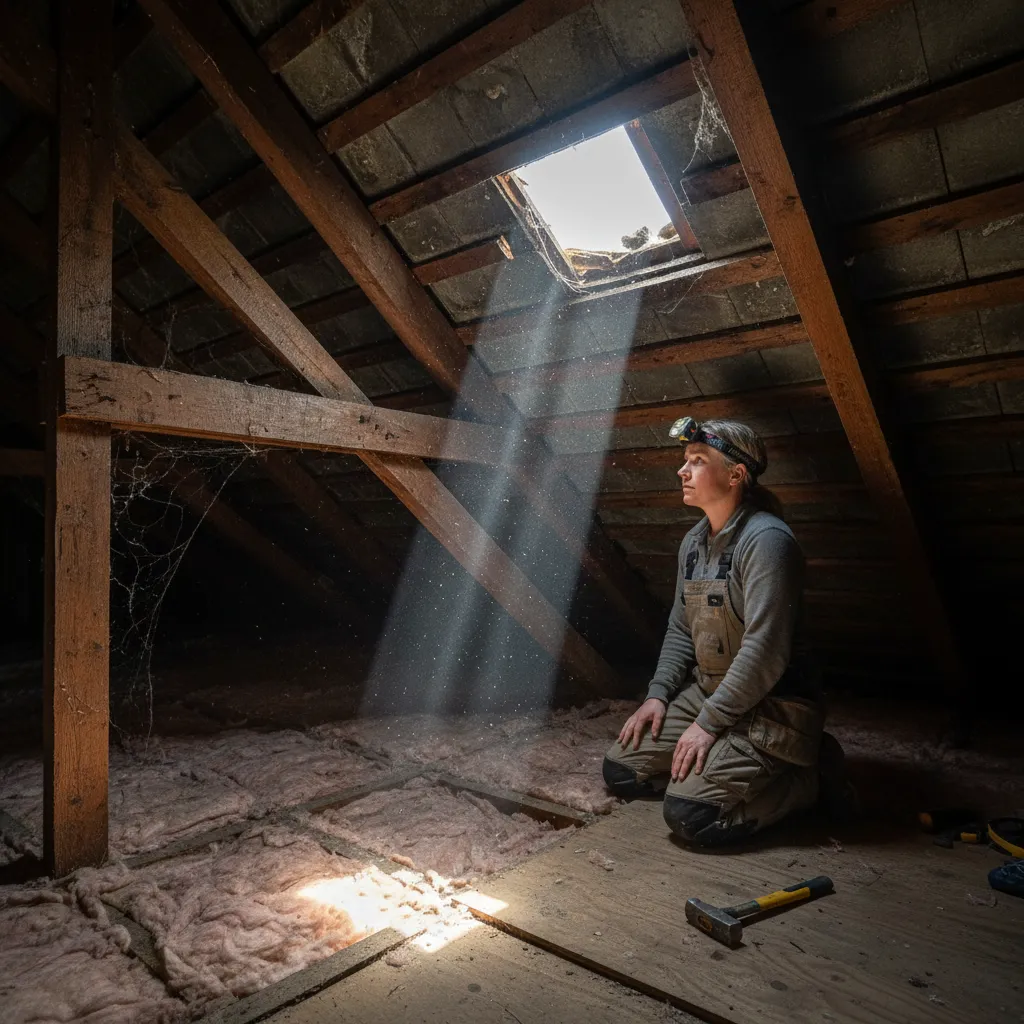
Your attic holds the most valuable clues. Before going up, prepare properly:
- Grab a powerful flashlight. A bright LED flashlight is your most important tool. Headlamps work even better because they free both hands.
- Wear old clothes and a dust mask. Attics are dirty, and disturbed insulation can irritate your lungs.
- Step only on ceiling joists or attic floorboards. Never step between joists onto the drywall — you can easily fall through the ceiling below.
- Bring your phone. Take photos of anything suspicious so you can show your roofer later.
Once you are safely positioned, use your flashlight to scan the underside of the roof decking in the area above and “upstream” from the interior stain. Look for these telltale signs:
- Dark stains or discoloration on the wood, which indicate past or recurring water contact
- Shiny or wet spots that glisten under your flashlight, indicating an active leak
- Water trails or streaks where moisture has been running along the underside of decking or down a rafter
- Mold or mildew (dark green, black, or white fuzzy patches), which confirms prolonged moisture exposure
- Compressed, stained, or matted insulation, which shows where water has been dripping or pooling
If you find a wet trail, follow it uphill. The trail will lead you toward the leak’s entry point. In many cases, you will trace it right back to a roof penetration or a joint in the decking.
Step 3: Investigate All Roof Penetrations
Here is a critical statistic: roughly 90% of roof leaks originate at flashings and penetrations, not in the open field of shingles. Your shingles are designed to shed water across a continuous surface. It is the points where something interrupts that surface — where pipes, vents, and structures pass through the roof deck — that create vulnerability.
In your attic, pay special attention to the areas surrounding these common leak sources:
- Plumbing vent pipes — The rubber pipe boot that seals around each vent degrades in Georgia’s intense UV exposure, typically cracking after 10–15 years. A failed pipe boot is the single most common residential roof leak.
- Exhaust fan vents — Kitchen and bathroom exhaust ducts that exit through the roof can develop gaps where their flashing meets the decking.
- Chimneys — The junction between a chimney and the roof surface uses step flashing and counter flashing, creating multiple potential failure points. Chimney leaks are among the most expensive to repair ($500–$1,500) because the flashing system is complex.
- Skylights — Skylight frames rely on a flashing kit and sealant that deteriorate over time. If your leak is near a skylight, the flashing is the prime suspect.
- Attic vents and ridge vents — Any vent designed to ventilate your attic is also a potential water entry point if its gaskets or flashing fail.
- Valleys — Where two roof slopes meet, water concentrates and flows at higher volume. Valley flashing that has corroded or shifted is a frequent leak source, especially on roofs over 15 years old.
Shine your flashlight all around where these items pass through the roof. This is often where you will find the source.
Step 4: Try the Water Test for Stubborn Leaks
Sometimes a leak only appears during a long, driving rain and is impossible to find when things are dry. If your attic inspection did not reveal an obvious source and you have a helper available, you can try to recreate the conditions that trigger the leak.
Here is the process:
- Station one person in the attic with a flashlight (and a phone to communicate)
- Have a second person outside with a garden hose — no high-pressure nozzle, just a gentle flow
- Start soaking a small area of the roof below the suspected leak zone, then slowly work upward
- Soak each section for 5–10 minutes before moving on. Patience is critical — some leaks take time to develop a visible drip
- When the attic observer spots water, immediately mark the location and note which roof section the hose was wetting
This method works particularly well for slow leaks around flashings and in valleys. It can save your roofer significant diagnostic time and you significant money on the repair.
Important: Only conduct this test in dry conditions with stable footing around the house. Never direct water near electrical lines or equipment.
Step 5: Understand What You Are Looking At
Not every water spot in your attic means a roof leak. Before you call for repairs, consider these other possible sources:
- Condensation — In winter, warm moist air from your living space rises into a cold attic and condenses on the underside of the roof decking. This looks like widespread dampness or frost, not a localized trail. The fix is improved attic ventilation and vapor barriers, not roof repair.
- HVAC condensation — If your air handler or ductwork runs through the attic, condensate line leaks or sweating ducts can mimic a roof leak.
- Bathroom exhaust fans venting into the attic — If a bathroom fan dumps humid air directly into the attic instead of through a roof vent to the outside, the moisture will condense on the decking and drip. This is a ventilation issue, not a roofing issue.
A professional inspector can distinguish between these sources quickly, potentially saving you from unnecessary roof work.
When to Call a Professional
Once you have gathered your observations — where the stain is, what you found in the attic, which penetrations look suspicious — it is time to call for a professional roof repair. Your detective work gives the repair team a significant head start, which often translates directly into a faster, less expensive fix.
Here are the situations that warrant an immediate call:
- Active dripping during or after rain — the leak is real and worsening
- Mold or mildew in the attic — indicates the leak has been present for weeks or months and remediation may be needed
- Sagging or soft spots in the decking — water has compromised the structural integrity of the roof
- Multiple stains in different areas — suggests systemic failure rather than a single point leak
- Any leak on a roof older than 20 years — the repair may reveal that a broader replacement conversation is warranted
Most roof leak repairs in North Georgia cost between $300 and $1,500, depending on the source and complexity. A simple pipe boot replacement runs $150–$400, while chimney or skylight flashing repairs range from $500–$1,500. The key is acting quickly — a $300 repair today can prevent $3,000–$5,000 in structural damage if left for 6–12 months.
Our team brings over 40 years of combined roofing experience serving homeowners across Canton, Dawsonville, and Blue Ridge. We will safely get on the roof, confirm the exterior source of the problem — whether it is failed flashing, a cracked pipe boot, or damaged shingles — and provide a permanent, professional repair backed by a written warranty.
Found the general area of your leak? Contact True Hand Roofing to have our experts pinpoint the source and provide a free repair estimate, or get an instant estimate to understand the scope of your roof’s needs.
Related reading: Why You Shouldn’t Ignore a Minor Roof Leak | 5 Overlooked Problems Found During a Professional Roof Inspection | The Cost of Roof Repair in Georgia