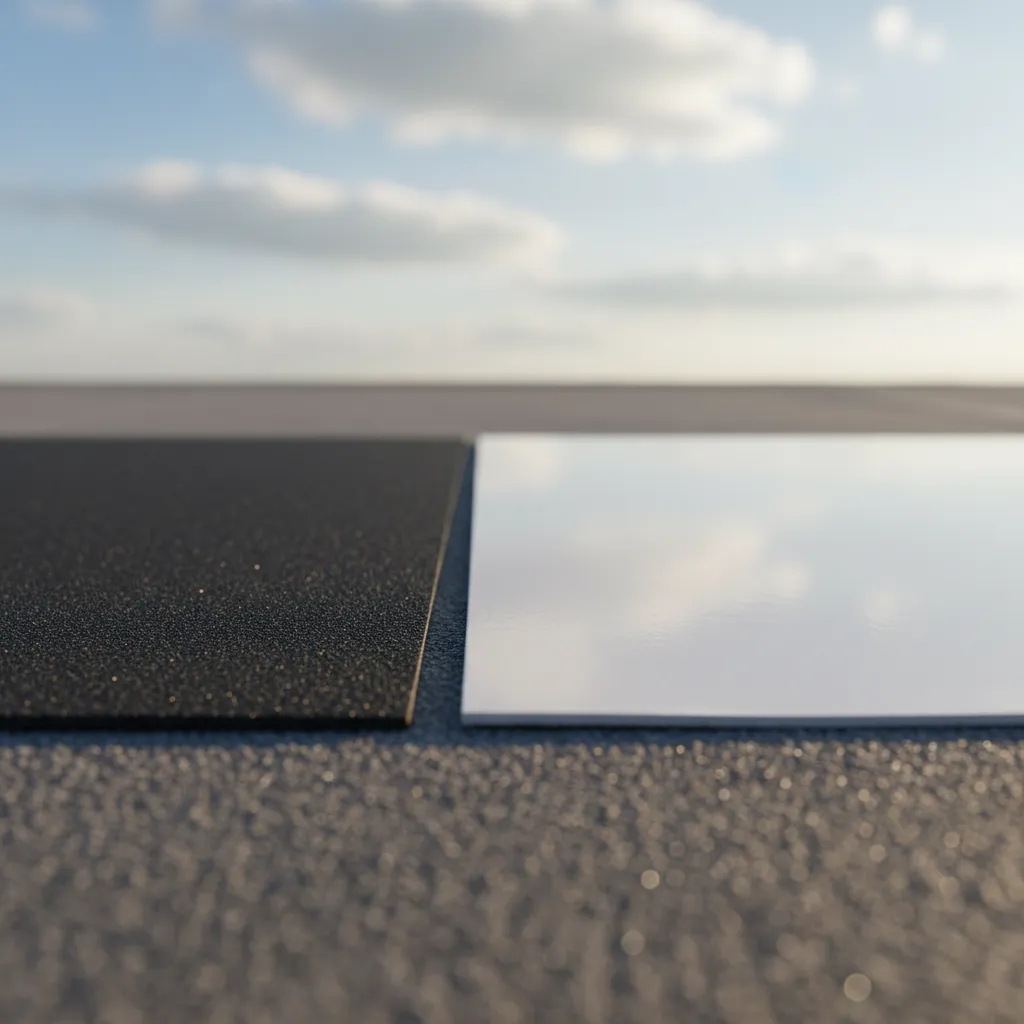
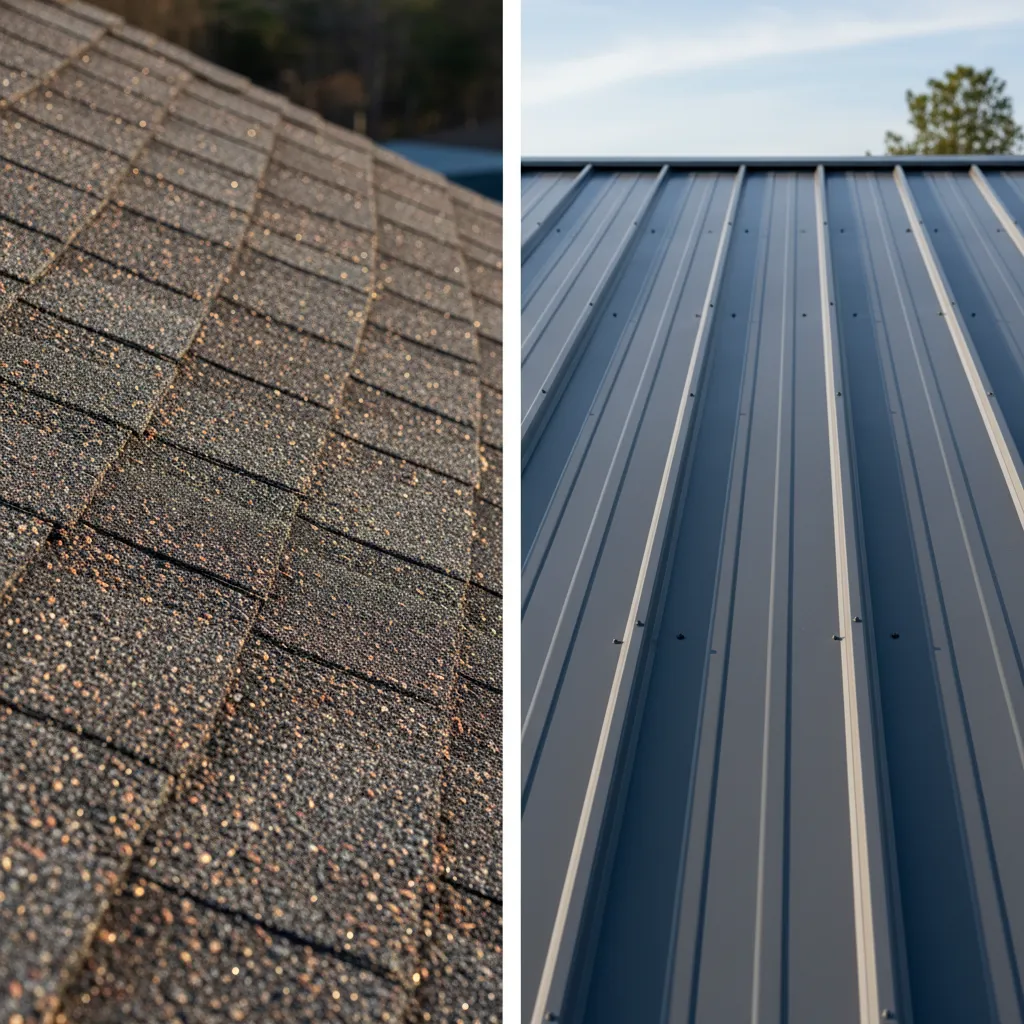
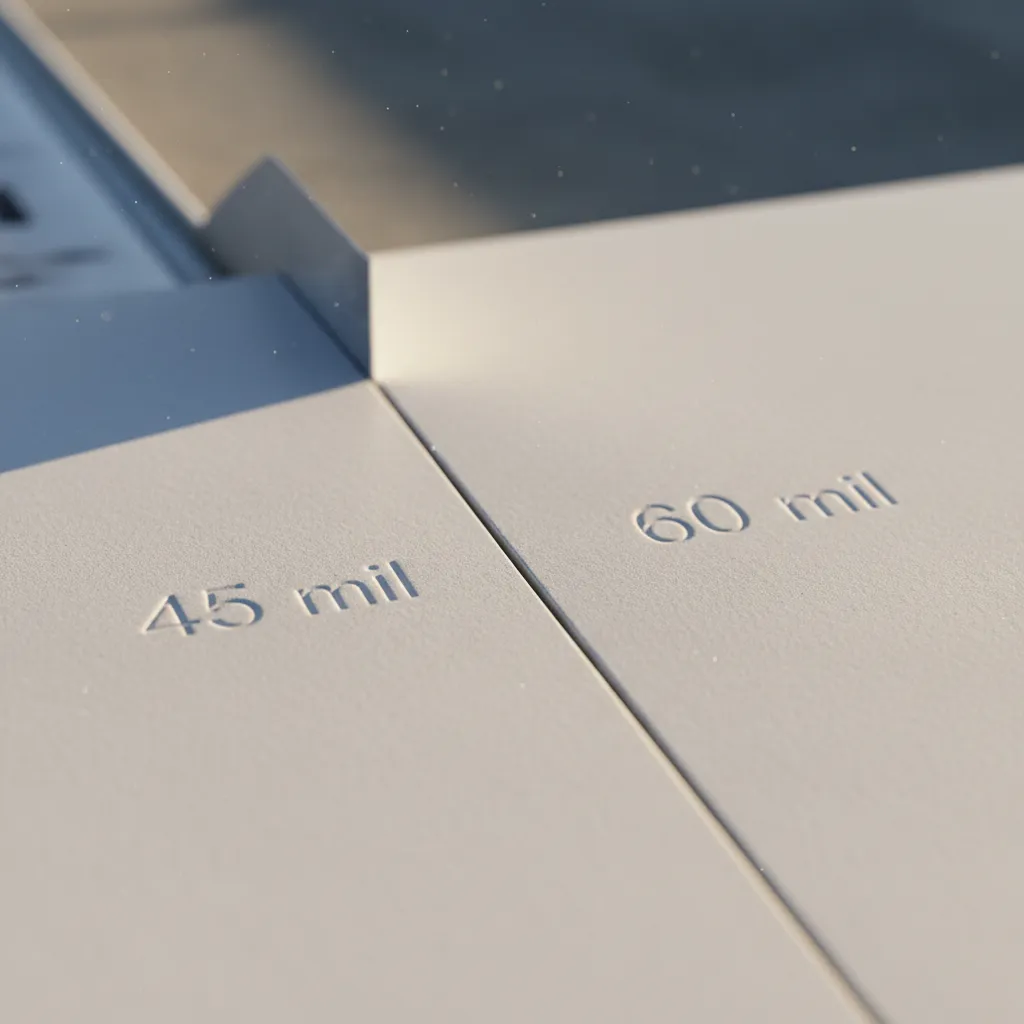
When it’s time for a new commercial roof, the conversation almost always comes down to two options: PVC (Polyvinyl Chloride) and TPO (Thermoplastic Olefin). These are the two dominant single-ply membrane systems in modern commercial roofing — both white, both reflective, both heat-welded, and both backed by strong manufacturer warranties. From the ground, they look nearly identical.
But beneath the surface, PVC and TPO are fundamentally different materials with different strengths, different weaknesses, and different ideal applications. Choosing the wrong one for your building can cost you tens of thousands of dollars over the roof's life. Our team brings 40+ years of combined experience installing both systems across North Georgia, and in this guide, we'll give you the complete, unbiased comparison so you can make the right choice for your building.
The Complete Comparison Table
Before diving into the details, here’s the side-by-side overview:
| Feature | PVC | TPO |
|---|---|---|
| Installed Cost | $7-$12/sqft | $5-$8/sqft |
| Lifespan | 25-30 years | 15-20 years |
| Chemical/Grease Resistance | Excellent (immune) | Poor (degrades) |
| Fire Rating | Class A (inherent) | Class A (with fire barrier) |
| Seam Welding | Wide temperature window | Narrow temperature window |
| Seam Track Record | 40+ years proven | 20+ years (improved recently) |
| Solar Reflectivity | 80-85% | 80-85% |
| Reflectivity Retention | Excellent (long-term) | Good (may yellow over time) |
| Puncture Resistance | Very good | Very good |
| Flexibility in Cold | Good (plasticizer-based) | Good (rubber polymer-based) |
| Warranty (NDL) | 20-25 years | 15-20 years |
| Best For | Restaurants, industrial, long-term holds | Offices, retail, warehouses, budget-conscious |
| 30-Year Cost (10K sqft) | ~$111,500 | ~$182,500 |
Now let's break down each category in detail.
Cost: TPO Wins Upfront, PVC Wins Long-Term
This is usually the first question, so let’s address it directly.
TPO: $5-$8 per square foot installed. TPO was specifically developed as a more affordable alternative to PVC, and it delivers on that promise. For a 10,000-square-foot commercial roof in Canton or Dawsonville, a TPO installation runs $50,000-$80,000. That's a significant savings that makes TPO attractive for budget-conscious building owners.
PVC: $7-$12 per square foot installed. PVC's more complex chemical formulation and thicker membrane construction command a premium. The same 10,000-square-foot roof costs $70,000-$120,000 — a difference of $20,000-$40,000.
But the 30-year story is different. PVC lasts 25-30 years; TPO lasts 15-20 years. Over a 30-year building hold, you'll install PVC once and TPO twice (including tear-off, disposal, and reinstallation). When you run the full lifecycle math, PVC's 30-year total is approximately $111,500 vs. TPO's $182,500 for a 10,000-square-foot roof. Read our detailed PVC lifecycle cost analysis for the complete breakdown.
Chemical and Grease Resistance: PVC Wins Decisively
This is the category where a clear winner emerges — and it’s the most important factor for certain building types.
PVC: PVC's molecular structure is inherently resistant to animal fats, vegetable oils, petroleum products, acids, alkalis, and a wide range of industrial chemicals. A PVC roof exposed to constant restaurant kitchen exhaust maintains its full strength and waterproofing integrity for its entire 25-30 year service life. This chemical inertness is built into PVC's DNA — it's not a coating or additive that can wear off.
TPO: TPO has reasonable general chemical resistance, but it is specifically not resistant to animal fats and cooking oils. Restaurant kitchen exhaust deposits these substances directly onto the roof surface, and they attack TPO's polymer structure. The membrane softens, swells, and loses tensile strength. In restaurant applications, TPO typically fails within 8-12 years — less than half its normal lifespan. TPO is also vulnerable to certain solvents and petroleum products that PVC shrugs off.
The bottom line: If your building has kitchen exhaust fans, chemical processes, or industrial emissions venting onto the roof, PVC is the only responsible choice. This isn't a preference — it's chemistry. For a deeper dive into this topic, read our guide on why PVC is the best choice for restaurants and industrial facilities.
Fire Resistance: PVC Has the Edge
Both PVC and TPO can achieve a Class A fire rating — the highest available — but they get there differently.
PVC: PVC is inherently fire resistant and self-extinguishing. When the flame source is removed, PVC stops burning. It achieves Class A fire ratings without requiring additional fire-barrier layers in most configurations. This inherent fire resistance is a significant advantage for restaurants, commercial kitchens, and industrial facilities where fire risk is elevated.
TPO: TPO requires supplemental fire-barrier layers (typically gypsum board or mineral fiber insulation installed beneath the membrane) to achieve a Class A rating. Without these additional layers, TPO's fire rating drops to Class B or lower. This adds material cost, labor cost, and complexity to the installation.
For building owners in Chatsworth and North Georgia, where many commercial buildings serve the food-service industry, PVC's built-in fire resistance simplifies both the installation and code compliance.
Seam Strength and Installation
Both PVC and TPO are thermoplastic membranes that use hot-air welding for seam joining — a significant advantage over EPDM’s adhesive-based seams. But the two materials behave differently during the welding process.
PVC: PVC has a wider "welding window" — meaning it can be effectively welded across a broader range of temperatures and travel speeds. This makes PVC somewhat more forgiving during installation, particularly in the hands-and-knees detail work around penetrations, curbs, drains, and flashings where robotic welders can't reach. PVC's hot-air welded seams have been proven in the field for over 40 years with an excellent track record.
TPO: TPO requires more precise temperature control from the welding equipment. The acceptable welding window is narrower, and under-welding or over-welding are more common if the equipment isn't calibrated correctly. Modern robotic welders have largely eliminated this issue for straight seam runs, but detail work still requires skilled technicians. TPO's seam technology has improved significantly in recent years, but it has a shorter field-proven track record (20+ years vs. PVC's 40+).
In both cases, proper installation by experienced, certified installers is critical. A perfectly welded TPO seam performs excellently. But PVC's wider margin for error and longer track record give it a measurable edge in seam reliability.
Energy Efficiency: A Virtual Tie
Both PVC and TPO are white, reflective membranes that qualify as “cool roof” systems. The initial performance numbers are nearly identical:
- Solar reflectivity: Both reflect 80-85% of solar radiation
- Thermal emittance: Both emit 75-80% of absorbed heat
- Cool-roof certification: Both qualify under Energy Star and CRRC standards
- Cooling cost reduction: Both reduce cooling costs by 15-25% vs. dark-colored roofs
The difference shows up over time. PVC tends to maintain its reflective surface longer because its surface chemistry resists dirt adhesion and UV-induced yellowing more effectively than TPO. After 10-15 years, a PVC roof typically retains a higher percentage of its original reflectivity than a same-age TPO roof. For building owners focused on long-term energy performance, PVC has a slight edge — but for the first 10-15 years, the two are functionally equivalent.
Lifespan and Durability
PVC: 25-30 years. PVC has been used in commercial roofing since the 1960s in Europe and the 1970s in the United States. This gives it one of the longest track records of any single-ply membrane. Buildings with original PVC installations from the 1980s are still performing well — providing real-world evidence of 30+ year service lives. PVC's plasticizer-based flexibility system, while occasionally criticized, has proven durable across decades of field performance.
TPO: 15-20 years. TPO is a newer product, first introduced in the 1990s. Early TPO formulations experienced some growing pains — including premature cracking, crazing, and seam failures — that manufacturers have since addressed through reformulation. Modern TPO (post-2010 formulations) is a significantly improved product, but it simply doesn't have the decades of field-proven data that PVC does. Current 15-20 year lifespan estimates are based on accelerated aging tests and extrapolation from the oldest installations.
Warranty Comparison
PVC: Major manufacturers (IB Roof Systems, Duro-Last, Sika Sarnafil) offer 20-25 year NDL (No Dollar Limit) warranties for certified installations. NDL means full coverage with no depreciation — if the roof fails in year 19, the manufacturer pays 100% of repair or replacement costs.
TPO: NDL warranties are available but typically top out at 15-20 years. Many standard TPO warranties are prorated, meaning coverage decreases annually. A prorated 20-year warranty might cover only 50% of costs at year 10 and 25% at year 15.
The Decision Framework: Which Is Right for Your Building?
After comparing every category, the choice comes down to your building’s specific needs:
Choose PVC if:
- Your building is a restaurant, food processing plant, or commercial kitchen
- Your facility handles chemicals, solvents, or petroleum products
- You plan to own the building for 15+ years
- Fire resistance is a priority (kitchens, industrial)
- You want the lowest 30-year total cost of ownership
- You want the strongest NDL warranty available
Choose TPO if:
- Your building is a standard office, warehouse, retail store, or non-food commercial space
- There is no chemical or grease exposure on your rooftop
- Budget is a primary concern and you need to minimize upfront cost
- You plan to sell the property within 10-15 years
- You want excellent energy efficiency at the best price point
Both are excellent roofing systems when matched to the right application. The worst decision isn't choosing one over the other — it's installing TPO on a restaurant or PVC on a budget warehouse. For a deeper look at TPO's energy-saving benefits, read our guide on how cool roofs save money in Georgia.
When to Call a Professional
Still not sure which membrane is right for your building? Our experienced commercial roofing team assesses your building’s specific needs — including chemical exposure, ownership timeline, budget, and performance requirements — and provides an honest recommendation with a detailed, no-obligation estimate.
Contact True Hand Roofing for a free commercial roof consultation, or get started with our free instant estimate tool. We serve commercial building owners across North Georgia, including Canton, Chatsworth, Dawsonville, and the surrounding communities.
Related reading: Why PVC Is the Best Roofing Choice for Restaurants and Industrial Facilities | Cool Roofs 101: How a TPO Roof Can Save You Money in Georgia