When building owners in Cherokee County and across North Georgia consider a metal roof retrofit, the conversation often starts with the sub-framing system that creates slope over a failing flat roof. But the component that ultimately determines how long your investment lasts — and how well it performs — is the roof surface itself: the standing seam metal panel system.
Standing seam metal is not just another roofing material. It's an engineered panel system specifically designed to eliminate the failure points that plague other commercial roofing options. With a lifespan of 40-60 years, wind resistance up to 140 mph, and zero exposed fasteners, it's the reason metal retrofits deliver truly permanent results. Our team brings 40+ years of combined experience with commercial metal systems, and in this guide, we'll explain exactly what makes standing seam the gold standard.
What Is a Standing Seam Metal Roof?
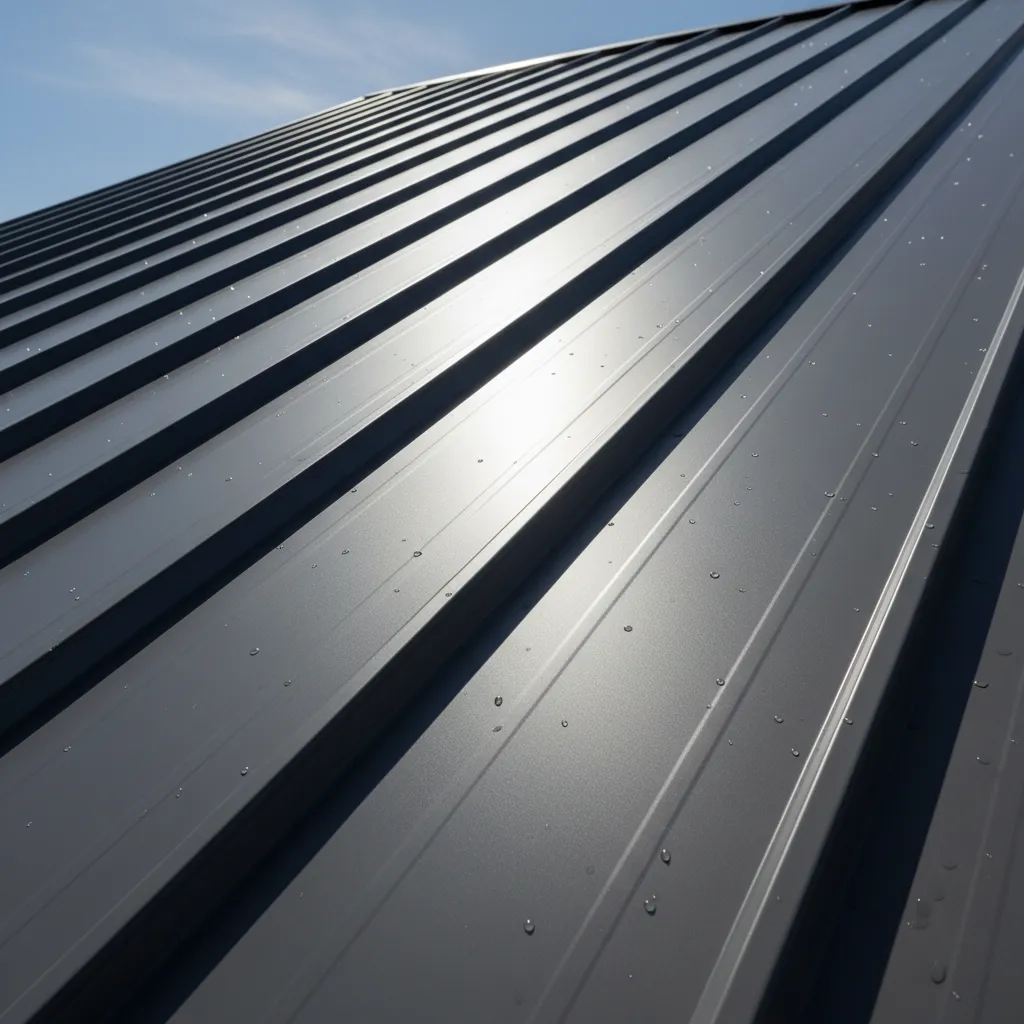
A standing seam roof consists of continuous metal panels that run vertically from the eave (bottom edge) to the ridge (peak) of the roof. The defining feature is the raised seam — the edges of adjacent panels are folded upward and interlocked, creating a raised rib that stands above the flat pan of the panel.
These seams are either mechanically locked together using a specialized seaming tool or snap-locked into place, depending on the panel profile. Either way, the result is a continuous, watertight connection between every panel on the roof. The seams typically stand 1 to 2 inches above the panel surface, creating a profile that's both functional and visually distinctive.
The panels themselves are manufactured from 24-gauge steel (the industry standard for commercial applications) or 26-gauge for lighter-duty residential projects. At 24-gauge, the steel is thick enough to resist impacts from hail, falling branches, and foot traffic during maintenance — critical considerations for commercial buildings in North Georgia's storm-prone climate.
The Critical Advantage: Concealed Fasteners
The single most important feature that separates standing seam from cheaper metal roofing options is its concealed fastening system. Understanding this distinction is essential to understanding why standing seam outperforms and outlasts the competition.
How it works: Instead of screws driven through the panel face, standing seam panels are secured with hidden clips. These clips are screwed to the roof deck or sub-framing, and the panel seam locks over them. The result: zero exposed screws or holes in the entire flat surface of the roof.
Why this matters — thermal movement: Metal expands and contracts significantly with temperature changes. In Chatsworth and North Georgia, where summer roof surface temperatures can exceed 160 degrees and winter temperatures drop below freezing, a 20-foot metal panel may expand and contract by nearly half an inch over the course of a year. The clip system allows panels to "float" — sliding smoothly over their clips as they expand and contract — without stressing any fastener or opening any hole.
The exposed-fastener problem: On cheaper screw-down metal roofs, every fastener penetrates the panel surface. As the metal moves with temperature changes, the screws gradually elongate their holes — a process contractors call "wallering out." Within 10-15 years, these enlarged holes begin to leak. A typical 10,000-square-foot exposed-fastener roof has 3,000-5,000 screws, each one a potential leak point. By contrast, a standing seam roof has exactly zero fastener penetrations across its entire surface.
Built to Last: Materials and Finishes
The panel material and coating system are just as important as the design. Commercial standing seam panels use a multi-layer construction engineered for decades of performance:
24-Gauge Galvalume Steel: The base material is steel coated with a zinc-aluminum alloy (Galvalume) that provides exceptional corrosion resistance. This combination delivers the structural strength needed to span between purlins, resist wind uplift, and handle foot traffic during maintenance — all while resisting rust for the life of the panel.
Kynar 500/PVDF Paint Systems: The exterior finish is not ordinary paint. Premium standing seam panels are coated with Kynar 500 or equivalent PVDF (polyvinylidene fluoride) resin-based coatings that are warrantied for 30-35 years against fading, chalking, and peeling. These finishes maintain their color and appearance for decades, even under the intense UV exposure of North Georgia summers.
Cool-Roof Reflective Technology: Many standing seam finishes incorporate reflective pigments that bounce back 25-40% of solar energy. Rather than absorbing heat and transferring it into your building, a cool-roof standing seam panel reflects it away. For commercial buildings running air conditioning 6-8 months per year, this reflectivity translates directly into lower energy bills — typically reducing cooling costs by 10-25% compared to a dark, non-reflective roof.
Wind and Weather Performance
Standing seam metal is one of the highest-performing roofing systems in severe weather, which matters in a region where spring thunderstorms, summer wind events, and occasional winter ice storms are facts of life.
Wind resistance: Quality standing seam systems are rated to withstand sustained winds of 110-140 mph, meeting or exceeding the requirements for the highest wind zones in the United States. The interlocking seam design and concealed clip attachment work together to create a roof surface that resists uplift forces far better than mechanically fastened or adhered single-ply membranes.
Impact resistance: The 24-gauge steel panels are inherently resistant to hail damage that would destroy asphalt shingles or puncture single-ply membranes. Most standing seam systems carry a Class 4 impact rating — the highest available.
Fire resistance: Steel is non-combustible, giving standing seam panels a Class A fire rating without any additional coatings or treatments. For commercial buildings, this is both a safety advantage and an insurance benefit.
Snow and ice performance: The smooth, raised-seam profile allows snow and ice to shed naturally rather than accumulating in heavy loads on the roof structure. This is particularly valuable for buildings in the higher elevations of North Georgia where winter weather is more severe.
Standing Seam in a Retrofit Application
While standing seam metal is excellent for new construction, it truly shines in commercial roof retrofit applications. Here’s why the combination is so effective:
In a retrofit, a new sub-framing system is installed directly over your existing failing flat roof — no tear-off required. This sub-framing creates positive slope (typically 1/4 inch per foot or more) so that water drains naturally rather than ponding. The standing seam panels are then installed on this new sloped surface.
The result is a roof system that solves every problem that plagued the original flat roof:
- No more ponding water — positive slope ensures complete drainage
- No more membrane failures — steel panels don’t blister, crack, or split
- No more seam separations — interlocked standing seams are mechanically bonded
- No more fastener leaks — concealed clips eliminate penetration points
- 40-60 year service life — versus 15-20 years for most flat roofing membranes
If you're tired of repatching the same failing flat roof every few years, a standing seam metal retrofit is the permanent solution that eliminates the cycle of repairs.
Cost and Long-Term Value
Standing seam metal roofing costs $8-$14 per square foot installed — significantly more than TPO ($5-$8/sqft), PVC ($7-$12/sqft), or EPDM ($4-$8/sqft). For a 10,000-square-foot commercial roof, that’s an investment of $80,000-$140,000.
However, the long-term math tells a different story. Over a 50-year period:
- Standing seam: One installation at $8-$14/sqft = $8-$14/sqft total
- TPO: 2-3 installations at $5-$8/sqft = $10-$24/sqft total
- EPDM: 2-3 installations at $4-$8/sqft = $8-$24/sqft total
Factor in the avoided tear-off costs, reduced maintenance, lower energy bills, and zero emergency leak repairs, and standing seam metal frequently delivers the lowest total cost of ownership over the life of a building. It's a higher upfront investment that pays for itself — often within the first 20 years.
When to Call a Professional
If your commercial building has a flat roof that’s failing, ponding water, or approaching the end of its warranty, a standing seam metal retrofit may be the last roofing decision you ever need to make. Our experienced team evaluates your building’s structural capacity, measures your existing roof, and designs a retrofit system tailored to your specific building.
Contact True Hand Roofing for a free retrofit consultation, or get started with our free instant estimate tool. We serve commercial building owners across North Georgia, including Cherokee County, Chatsworth, Canton, and the surrounding communities.
Related reading: Can My Building Support a Metal Retrofit? A Structural Guide | Don’t Replace — Retrofit: The Smart Solution for a Failing Flat Roof