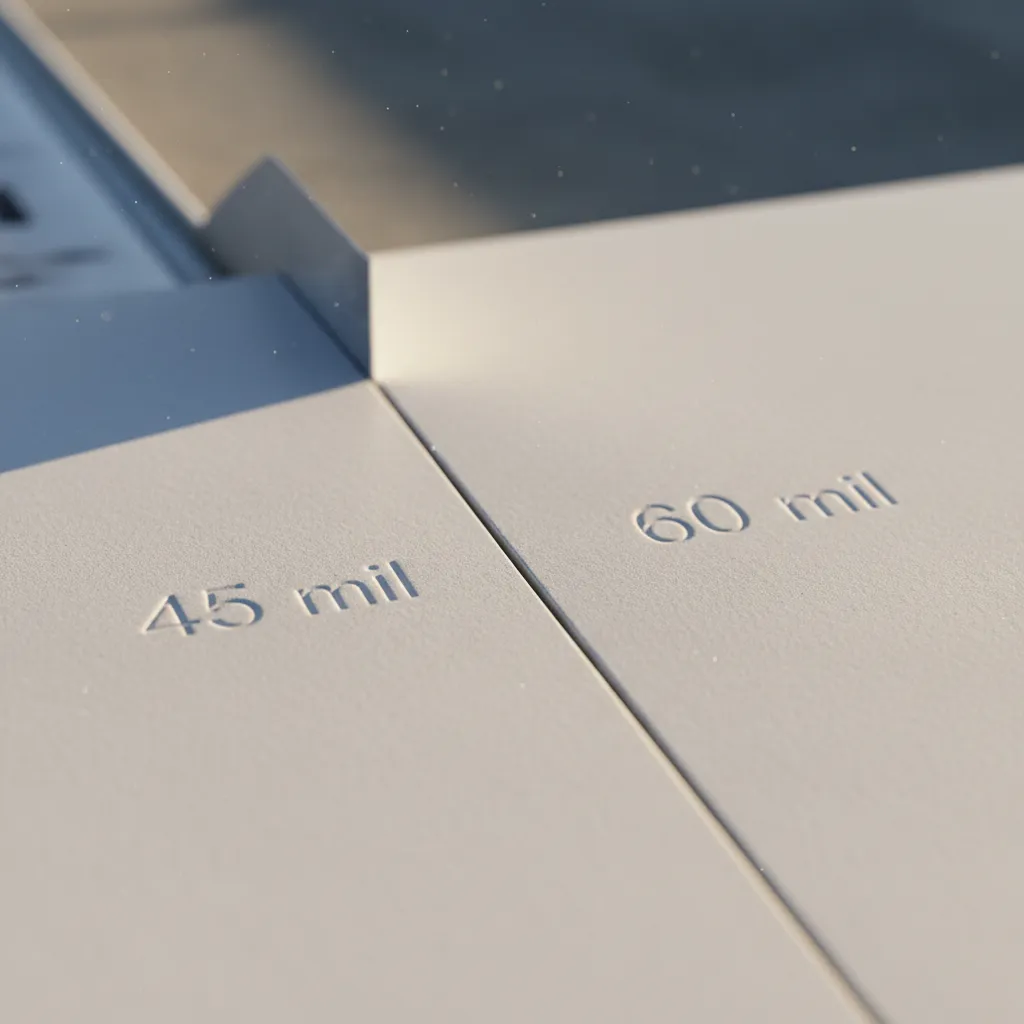
When you’re investing in a new TPO roofing system for your commercial building in Canton, Blue Ridge, or Jasper, one of the most important decisions you’ll face is the thickness of the membrane itself. The three standard options — 45 mil, 60 mil, and 80 mil — differ significantly in performance, lifespan, and cost. A “mil” is one-thousandth of an inch, so the actual thickness differences are measured in fractions of a millimeter. But those fractions make a surprisingly large difference in how your roof performs over 20 or 30 years.
Our team brings over 40 years of combined experience installing commercial roofing systems, and for the majority of buildings we work on, we recommend 60 mil as the baseline. Here’s the full breakdown of why — and when the other thicknesses make sense.
Understanding TPO Membrane Construction
Before comparing thicknesses, it helps to understand what you’re actually paying for inside a TPO membrane. Every TPO sheet, regardless of thickness, is built from three layers:
The Top Weathering Layer. This is the white surface exposed to the sun and elements. It contains UV stabilizers, reflective pigments, and the chemical compounds that give TPO its cool-roof properties. A thicker membrane has a proportionally thicker weathering layer, which is the primary reason thicker membranes last longer.
The Reinforcement Scrim. Embedded in the center of the membrane is a woven polyester fabric that provides tensile strength, tear resistance, and dimensional stability. This scrim is essentially the structural backbone of the membrane. It’s similar across all thicknesses, though heavier scrims are used in thicker membranes.
The Bottom Bonding Layer. This layer is what bonds to the substrate (in adhered systems) or sits against the insulation (in mechanically attached systems). It’s also what fuses with the overlapping sheet during heat welding.
When you upgrade from 45 mil to 60 mil, the biggest increase is in the top weathering layer — the part of the membrane that absorbs UV radiation, withstands foot traffic, and resists punctures. That 33% increase in total thickness translates to roughly 40-50% more material above the reinforcement scrim, which is where the real durability gains come from.
Side-by-Side Thickness Comparison
Here’s how the three standard TPO thicknesses stack up across the metrics that matter most to building owners:
| Specification | 45 mil TPO | 60 mil TPO | 80 mil TPO |
|---|---|---|---|
| Installed cost (per sqft) | $4.50-$6.50 | $5.50-$8.00 | $7.00-$10.00 |
| Typical warranty | 15-20 years | 20-25 years | 25-30 years |
| Expected service life | 15-22 years | 22-30 years | 28-35 years |
| Puncture resistance | Baseline | 2x baseline | 3x baseline |
| Tear resistance | Good | Very good | Excellent |
| Foot traffic tolerance | Light/occasional | Moderate/regular | Heavy/frequent |
| Solar reflectance | 80-90% | 80-90% | 80-90% |
| Energy savings | 10-30% | 10-30% | 10-30% |
| Weight | ~0.29 lbs/sqft | ~0.38 lbs/sqft | ~0.52 lbs/sqft |
Notice that solar reflectance and energy savings are identical across all three thicknesses. The energy-saving benefits of a TPO cool roof come from the white reflective surface, not the membrane thickness. What changes with thickness is purely mechanical: how long the roof lasts and how much abuse it can take.
The Case for 45 mil: When Budget Is the Priority
A 45 mil TPO membrane is a legitimate roofing product that meets industry standards and will protect your building when properly installed. At $4.50-$6.50 per square foot, it’s the most affordable TPO option and offers a meaningful upgrade over aging built-up or modified bitumen roofs.
Where 45 mil makes sense:
- Budget-constrained projects where a new roof is needed immediately
- Low-traffic roofs with few penetrations and minimal maintenance access needs
- Buildings with a shorter ownership horizon (planning to sell within 10-15 years)
- Temporary or auxiliary structures (storage buildings, covered parking)
The trade-offs:
The thinner weathering layer means less protection against UV degradation over time, and the lower puncture resistance makes it more vulnerable to foot traffic damage, dropped tools, and storm debris. A 45 mil roof in North Georgia’s climate will typically deliver 15-20 years of good service, but it may show signs of wear earlier than its thicker counterparts.
The Case for 60 mil: The Sweet Spot
For the majority of commercial buildings we work on across North Georgia, 60 mil TPO is our standard recommendation. The incremental cost over 45 mil — typically $1.00-$1.50 per square foot more, or a 15-20% increase on the total project — buys substantially more protection and longevity.
Key advantages of 60 mil:
- 2x the puncture resistance of 45 mil, critical for roofs with HVAC equipment, satellite dishes, or other service points that require regular technician access
- 33% thicker weathering layer that withstands Georgia’s intense UV exposure for 5-10 additional years before showing signs of degradation
- Longer manufacturer warranties — most manufacturers offer 20-25 year NDL (no-dollar-limit) warranties on 60 mil installations, compared to 15-20 years for 45 mil
- Better seam performance — the thicker material produces a more robust heat-welded seam with greater margin for error
For a 10,000-square-foot commercial building, upgrading from 45 mil to 60 mil typically adds $10,000-$15,000 to the project cost. In exchange, you get an estimated 5-10 additional years of service life and significantly better protection against the day-to-day hazards that commercial roofs face. That’s one of the best returns on investment in commercial construction.
The Case for 80 mil: Maximum Protection
At $7.00-$10.00 per square foot, 80 mil TPO is the premium option. It’s not necessary for every building, but for the right applications, it provides unmatched durability and the longest service life available in single-ply roofing.
Where 80 mil excels:
- High-traffic roofs with multiple HVAC units requiring frequent service visits
- Buildings in heavily wooded areas where falling branches pose a regular puncture risk
- Manufacturing or industrial facilities where rooftop equipment installation is ongoing
- Building owners who want the absolute longest warranty and lowest lifecycle cost
- Roofs with limited slope where standing water (ponding) occurs after heavy rain
The 80 mil membrane’s 3x puncture resistance over 45 mil and 25-30 year warranty make it the go-to choice when durability is the top priority and the higher upfront cost fits the project budget.
20-Year ROI Analysis: Which Thickness Saves the Most Money?
The true cost of a roof isn’t what you pay on day one — it’s the total cost of ownership over the system’s lifespan. Let’s compare all three thicknesses for a 10,000-square-foot commercial building over a 20-year period:
| Cost Factor | 45 mil | 60 mil | 80 mil |
|---|---|---|---|
| Initial installation | $45,000-$65,000 | $55,000-$80,000 | $70,000-$100,000 |
| Expected replacement at year | 18 (prorated) | None needed | None needed |
| Estimated repair costs (20 yr) | $8,000-$12,000 | $4,000-$7,000 | $2,000-$4,000 |
| Total 20-year cost | $53,000-$77,000 | $59,000-$87,000 | $72,000-$104,000 |
| Cost per year | $2,650-$3,850 | $2,950-$4,350 | $3,600-$5,200 |
At first glance, 45 mil appears cheapest. But stretch the analysis to 30 years — the full expected lifespan of a 60 mil membrane — and the picture changes dramatically:
| 30-Year Scenario | 45 mil | 60 mil | 80 mil |
|---|---|---|---|
| Number of roofs needed | 1.5-2 | 1 | 1 |
| Total 30-year cost | $80,000-$130,000 | $63,000-$91,000 | $74,000-$108,000 |
| Cost per year | $2,667-$4,333 | $2,100-$3,033 | $2,467-$3,600 |
Over a 30-year ownership horizon, 60 mil TPO delivers the lowest total cost of ownership — making it the best long-term value for most commercial buildings.
Georgia-Specific Considerations
North Georgia’s climate puts unique demands on commercial roofing membranes:
UV Exposure. Georgia receives approximately 200-220 sunny days per year, with intense UV radiation during the long summer season. The thicker weathering layer on 60 mil and 80 mil membranes provides a larger buffer against UV-driven degradation.
Hail and Storms. Severe thunderstorms with hail are common from March through October. While all TPO thicknesses perform well against typical hail events, the 60 mil and 80 mil membranes offer measurably better resistance against larger hailstones (1 inch and above).
Thermal Cycling. North Georgia temperatures can swing 40-50 degrees in a single day during spring and fall. While TPO is inherently flexible and handles thermal cycling well, thicker membranes experience less stress per cycle, contributing to longer service life.
Georgia Building Code. Georgia’s commercial building energy codes specify minimum roof insulation R-values but do not mandate a specific membrane thickness. However, most manufacturer warranties that meet specifier requirements for institutional and government projects require 60 mil minimum.
When to Call a Professional
Choosing the right TPO thickness is one part of a larger system design that includes insulation type and thickness, attachment method, and flashing details. The wrong combination can undermine even the thickest membrane.
If you’re planning a commercial roof replacement or new construction project, our team can evaluate your building’s specific needs — foot traffic patterns, equipment density, wind exposure, and budget constraints — and recommend the right membrane thickness as part of a complete system design.
For most buildings, we’ll recommend 60 mil as the foundation. For high-traffic or high-exposure applications, we’ll explain exactly why 80 mil is worth the premium. And for budget-sensitive projects, we’ll show you how to get the best performance from a 45 mil system.
Contact True Hand Roofing for a free commercial roof assessment, or get an instant estimate to compare TPO options for your building.
Related Articles
Explore more about TPO roofing systems: