Not every commercial roof faces the same challenges. An office building, a warehouse, and a restaurant may look similar from the street, but the demands placed on their roofing systems are vastly different. For restaurants, food processing facilities, and industrial buildings, the roof must withstand chemical and biological agents that would destroy standard roofing materials within years.
This is where PVC (Polyvinyl Chloride) roofing stands apart from every other option on the market. At $7-$12 per square foot installed, PVC carries a premium price tag — but for buildings exposed to grease, chemicals, or both, it's the only membrane that delivers reliable, long-term protection. Our team brings 40+ years of combined experience with commercial roofing systems, and in this guide, we'll explain exactly why PVC is the right tool for the toughest jobs.
The Restaurant Roof Problem: Grease Destroys Most Membranes
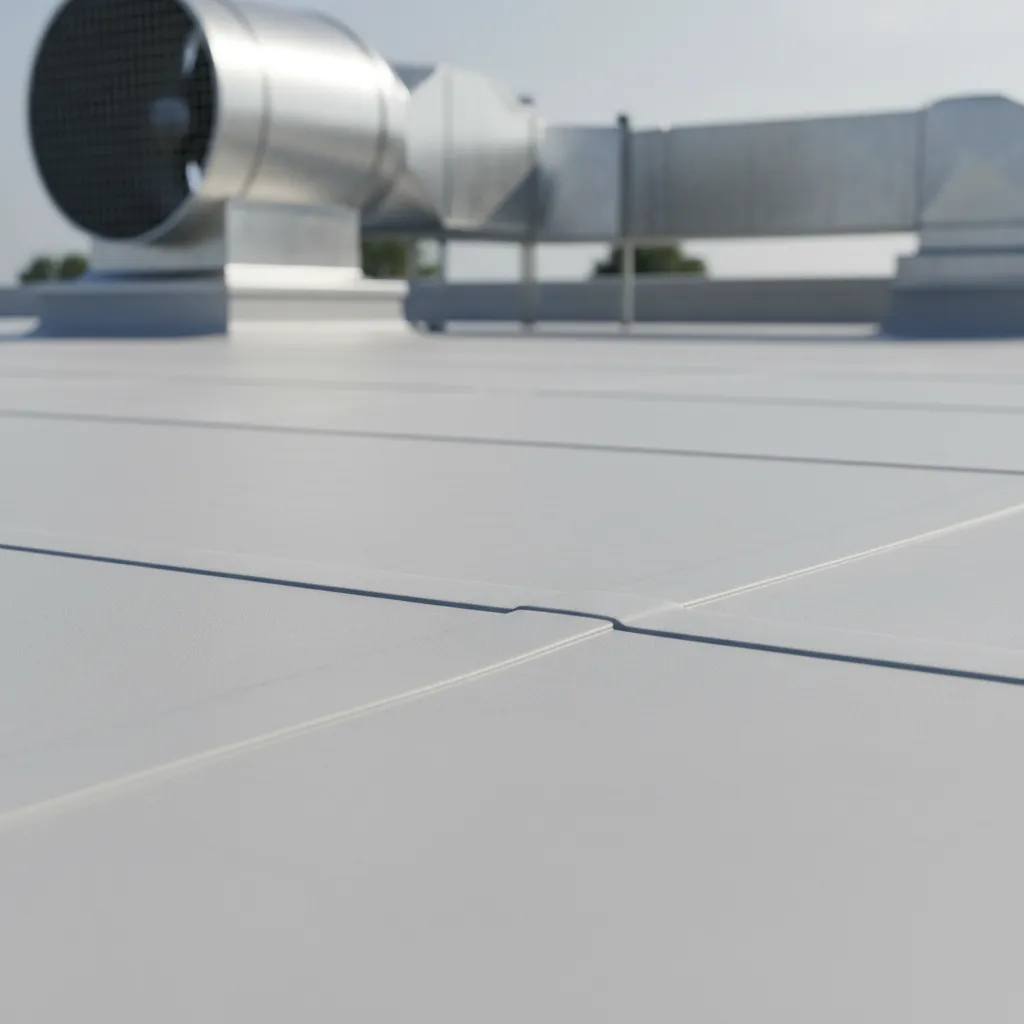
Every commercial kitchen with a rooftop exhaust fan creates the same problem: grease-laden vapor is expelled through the exhaust system and settles on the surrounding roof surface. Walk onto any restaurant roof that’s been in operation for a few years and you’ll see a visible grease deposit pattern radiating outward from each exhaust fan — sometimes extending 10-15 feet in every direction.
For most roofing materials, this grease exposure is a death sentence:
- TPO (Thermoplastic Olefin): Animal fats and cooking oils attack TPO’s polymer structure, causing the membrane to soften, swell, and lose tensile strength. A TPO roof on a busy restaurant typically shows visible degradation within 5-8 years and may fail completely in 8-12 years — less than half its normal lifespan.
- EPDM (Rubber Roofing): EPDM absorbs oils and fats like a sponge. The membrane swells, adhesive bonds fail, and seams separate. EPDM on a restaurant roof is a liability, not a solution.
- Modified Bitumen: The asphalt base in modified bitumen membranes is directly attacked by animal fats, leading to accelerated deterioration and brittleness around exhaust areas.
PVC is chemically immune to this problem. Its molecular structure — based on chlorine atoms bonded to a carbon backbone — does not react with animal fats, vegetable oils, or cooking grease. A PVC membrane exposed to constant kitchen exhaust maintains its full strength, flexibility, and waterproofing integrity for its entire 25-30 year service life.
Industrial Chemical Resistance
Restaurants aren’t the only buildings with aggressive rooftop environments. Manufacturing plants, chemical storage facilities, automotive shops, and processing centers all expose their roofs to substances that can destroy standard roofing materials.
PVC membranes resist a broad spectrum of industrial chemicals:
- Acids and alkalis — from manufacturing processes, battery storage, and cleaning operations
- Petroleum-based solvents — from fuel storage, machining, and automotive operations
- Industrial exhaust fumes — from processing equipment, boilers, and generators
- Fertilizers and agricultural chemicals — from farming operations and storage facilities
For business owners in Canton, Blue Ridge, and Dawsonville, where light manufacturing, food service, and agricultural operations are common, PVC provides the chemical resilience these facilities demand. No other single-ply membrane offers this breadth of chemical resistance.
Hot-Air Welded Seams: The Strongest Bond in Commercial Roofing
PVC is a thermoplastic material, which means it can be repeatedly softened with heat and re-fused. This property enables one of PVC’s greatest strengths: hot-air welded seams.
During installation, a robotic welding machine applies precisely controlled hot air (typically 900-1,100 degrees Fahrenheit) to the overlapping edges of adjacent membrane sheets. The heat softens both layers, and pressure rollers fuse them into a single, monolithic piece. The resulting weld is actually stronger than the membrane itself — a properly welded PVC seam will not fail before the surrounding membrane does.
Compare this to alternative seaming methods:
- Adhesive seams (EPDM): Rely on chemical adhesive that can degrade over time, especially in high-heat environments. Seam failures are the number one cause of leaks on EPDM roofs.
- Tape seams (some TPO systems): Use double-sided tape that’s vulnerable to temperature extremes and chemical exposure.
Hot-air welded seams create a truly watertight, chemical-resistant surface with no adhesive to degrade and no tape to fail. On a restaurant or industrial roof where the membrane is constantly exposed to aggressive substances, this seam integrity is the difference between a roof that lasts 25 years and one that starts leaking in 5.
Fire Resistance: Critical for High-Risk Environments
Fire safety is a paramount concern for restaurants with commercial kitchens, grease traps, and exhaust systems — and for industrial facilities handling combustible materials. PVC provides an inherent fire safety advantage that most other roofing materials cannot match.
Self-extinguishing properties: PVC is formulated to be self-extinguishing. When the flame source is removed, PVC stops burning. It does not continue to combust or spread flames across the roof surface. Most PVC roofing systems achieve a Class A fire rating — the highest classification available — without requiring additional fire-retardant layers or coatings.
By contrast, TPO has a lower inherent fire resistance and typically requires additional fire-barrier layers to achieve a Class A rating, adding complexity and cost to the installation. EPDM, being rubber-based, is combustible and achieves lower fire ratings without supplemental protection.
For building owners, a Class A fire-rated roof isn't just about safety — it often translates to lower insurance premiums and easier compliance with local building codes, many of which require Class A roofing for food-service and industrial occupancies.
Energy Efficiency: Cool-Roof Performance
Beyond its specialized resistances, PVC delivers the same energy efficiency benefits as other white, reflective single-ply membranes. Its bright white surface reflects up to 80-85% of solar radiation, significantly reducing the amount of heat transferred into the building below.
For restaurants and industrial facilities running refrigeration, HVAC, and processing equipment, keeping the building cooler reduces the load on air conditioning systems. In North Georgia's hot summers, a reflective PVC roof can reduce cooling costs by 15-25% compared to a dark-colored roof — savings that compound over the roof's 25-30 year life.
This reflective performance also helps the membrane itself last longer by reducing thermal stress. A PVC roof that stays cooler experiences less expansion and contraction, less UV degradation, and less thermal fatigue at the seams.
PVC vs. Other Membranes: Why the Premium Is Worth It
PVC typically costs $7-$12 per square foot installed, compared to $5-$8 for TPO and $4-$8 for EPDM. On a 10,000-square-foot restaurant roof, that’s a premium of $20,000-$40,000 upfront. So why pay more?
Because for a restaurant or industrial facility, the alternatives aren't actually cheaper — they just shift the cost into the future:
- TPO on a restaurant: $50,000-$80,000 installed, but fails in 8-12 years due to grease exposure. Over 25 years, you’ll install TPO 2-3 times: $100,000-$240,000 total.
- PVC on a restaurant: $70,000-$120,000 installed, lasts the full 25-30 years with minimal maintenance. One installation, one cost.
When you factor in the avoided tear-off and disposal costs, business disruption during re-roofing, and emergency repair expenses, PVC's premium disappears entirely. For buildings with aggressive rooftop environments, PVC isn't the expensive option — it's the only option that makes financial sense. Read our detailed PVC vs. TPO comparison and PVC lifecycle cost analysis for a deeper look at the numbers.
When to Call a Professional
If you own a restaurant, food processing facility, or industrial building — or if your current roof is showing signs of chemical or grease damage — it’s time for a professional assessment. Our experienced commercial roofing team evaluates your building’s specific exposure profile and recommends the right membrane system for your environment.
Contact True Hand Roofing for a free commercial roof consultation, or get a quick ballpark with our free instant estimate tool. We serve restaurant and industrial building owners across North Georgia, including Canton, Blue Ridge, Dawsonville, and the surrounding communities.
Related reading: PVC vs. TPO: A Head-to-Head Comparison for Commercial Roofs | Long-Term Value: Why a PVC Roof’s Higher Cost Is a Smart Investment