
There is an article on this site about finding a roof leak from inside your home, and most of it assumes something that is true of most houses: that a person lives there, and that the person noticed something.
In a second home, that assumption does not hold. Nobody heard the drip. Nobody saw the stain when it was the size of a coin. The leak had the run of the place for however long it has been since you were last up.
That single difference changes everything about how you go looking — and it is a common enough situation across our footprint that it deserves its own treatment.
This is a second-home market, and the numbers show it
Look at the year-round populations of the places we work in Fannin and Gilmer County. Cherry Log recorded 99 residents at the 2020 census. Mineral Bluff recorded 223. Epworth recorded 668. Morganton recorded 285.
Anyone who has driven those roads knows there are a great deal more houses than that suggests. The gap is the second homes, the family cabins and the short-term rentals — housing that exists here in numbers the resident count never captures.
Big Canoe, the mountain community of over 8,000 acres straddling Pickens and Dawson County near Jasper, is one of the few places around here that publishes the split directly: roughly 3,000 residents, of whom about 60% are full-time and 40% are part-time or vacation homeowners. Four homes in ten, empty for stretches, by design.
That is the population this article is written for. Not a different roof — a different observer.
What time does to a small leak
The reason a discovery gap matters is that roof damage is not linear. A leak does not simply get bigger; it moves through stages, and each stage costs more than the last.
Days. Water enters at a failure — a split pipe boot, a lifted shingle, an open flashing lap — and wets the decking underneath. Nothing is visibly wrong from inside. In an occupied house this is often already audible.
Weeks. The decking stays damp between rainfalls instead of drying between them. Insulation directly below takes on water, compresses, and stops insulating. In a closed-up house with no air movement, this is where the smell starts.
A season. Repeated wetting without drying is the condition wood rot needs. Sheathing softens. Framing members in the wet path start to take on moisture. Fasteners in the wet zone begin to corrode. Now the repair is not a flashing detail — it is a flashing detail plus decking replacement, and possibly insulation.
A year or more. The wet path has found the finished surfaces. Ceiling drywall, trim, flooring below the drip line. In a cathedral-ceiling cabin — which is most of them up here — there is no attic for the water to sit in first, so it arrives at finished ceiling sooner than it would in a conventional house.
The failure that started this was often a $200 to $400 pipe boot. The difference between the two ends of that timeline is entirely the number of months nobody was standing under it.
The arrival walkthrough, in order
Do this before you unload the car. It takes fifteen minutes and it is the highest-value thing you will do on the trip.
1. Stand still inside and smell. Do not open the windows yet. A closed house that has been taking water smells musty and earthy in a way stale air does not. This is your most sensitive instrument and it works before any stain is visible. If it smells wrong, everything below becomes deliberate rather than casual.
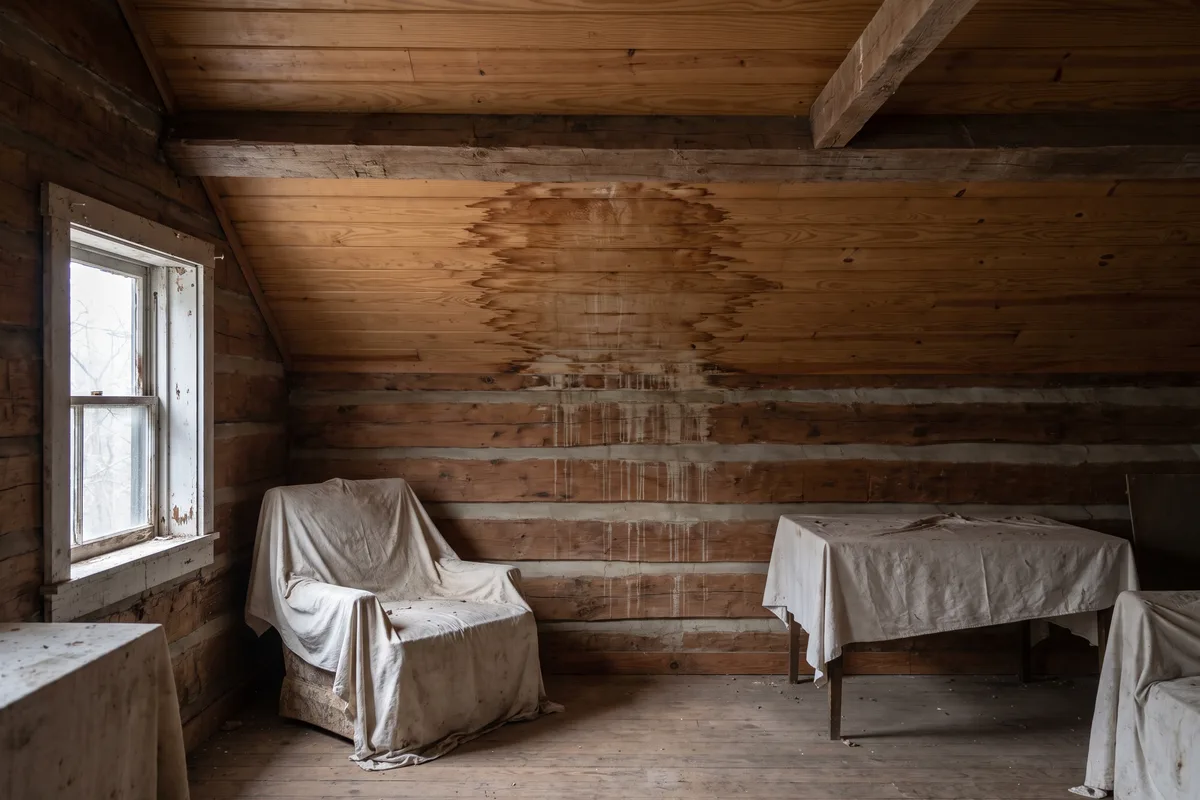
2. Ceilings, highest floor first, with a light. Overhead lighting flattens a ceiling and hides a stain. Take a flashlight or a phone light and rake it across the ceiling at a shallow angle — a dried water stain and a subtle sag both show up under raking light and vanish under a bulb directly above them.
3. The places nobody looks. Closet ceilings. Behind doors that stand open. The top of the ceiling in a stairwell. Under a loft. In an occupied house these get seen incidentally a thousand times a year; in a cabin they can go a decade without a glance, which is precisely why a stain survives there undetected.
4. Around every penetration, from below. Stand under each one and look at the ceiling: chimney, skylight, bath fan, plumbing vent stack, any roof-mounted equipment. The large majority of leaks originate at penetrations and flashings rather than in the open field of shingles, so this is where the odds are.
5. Touch, do not just look. Press a fingertip to any suspect ceiling area. Damp, cool, soft or slightly yielding drywall tells you something a photograph will not. Compare against a section you know is dry.
6. The attic, if you have one. Same drill, with a flashlight held low so it rakes across the underside of the decking: dark staining, shiny wet patches, water trails down rafters, matted or compressed insulation, mould. Step only on joists. If your cabin is a vaulted or cathedral build with no accessible attic, you have no such step — which is exactly why the interior indicators above matter more in that kind of house.
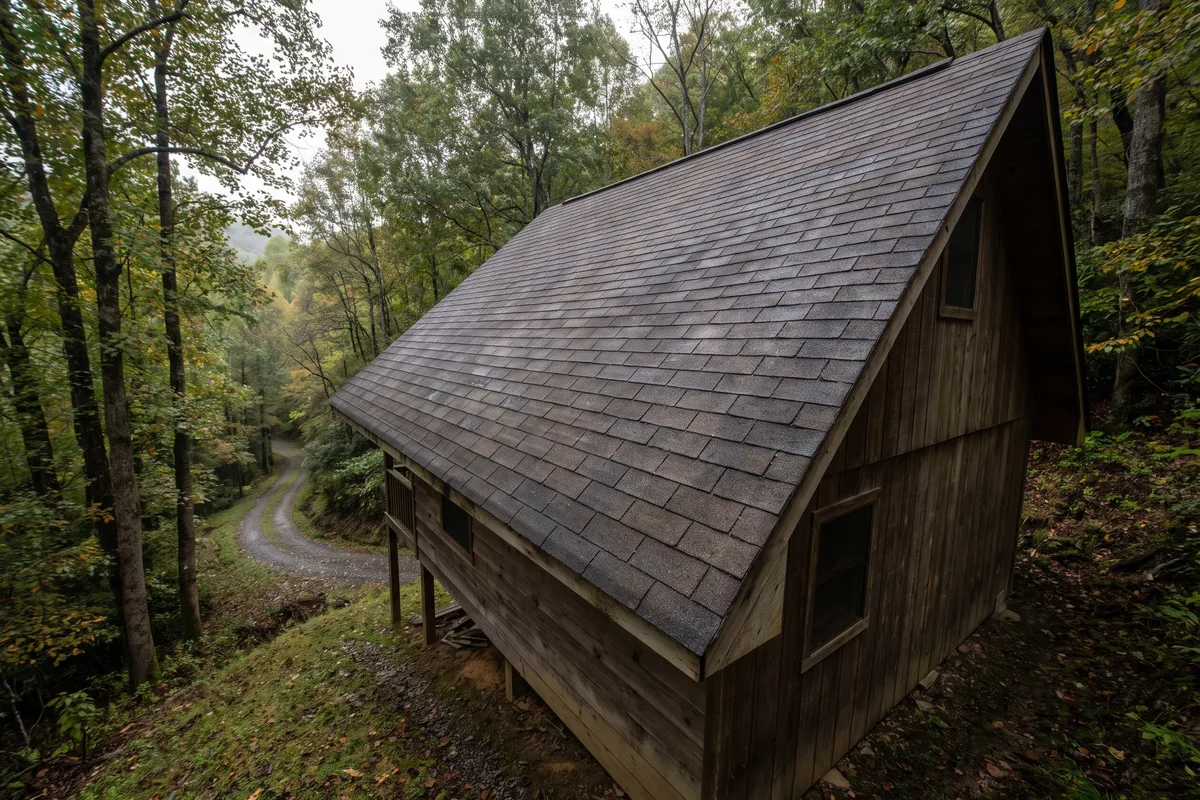
7. Only then, the exterior, from the ground. Walk the perimeter. Debris packed in the valleys, a downspout that is not running, a shingle in the yard, granule piles at the downspout outlets, a limb resting on a slope. Stay on the ground. A mountain cabin pitch is not a surface to go investigate on, wet or dry.
What leaks in an empty house that is not the roof
Before anyone spends money on shingles, rule these out. A cabin has failure modes an occupied house mostly does not, because a resident interrupts them early.
- Plumbing. A supply line that lets go with nobody home does not stop. This is the reason people shut the water off at the main when they leave, and it is a good habit.
- Water heater. Tanks fail on their own schedule, often quietly, and a slow one produces a wet floor and a smell rather than a flood.
- HVAC condensate. A clogged condensate line on an attic air handler overflows onto the ceiling below and produces a stain that looks exactly like a roof leak. If your stain is near the air handler, suspect this first.
- Bath fan ducted into the attic. Endemic in older cabins. Warm, wet air is dumped into a cold attic, condenses on the underside of the decking, and drips. It presents as widespread dampness across the deck rather than one localised trail, and it is a ventilation problem, not a roofing one.
- Winter condensation generally. A closed, unheated house with a cold roof deck can condense moisture on that deck without any roof failure at all.
An honest inspection distinguishes between these, and the distinction is worth real money. Replacing a pipe boot does not fix a condensate line.
Changing the odds before you leave
You cannot inspect a cabin you are not standing in. What you can do is shorten the gap and reduce what accumulates in it.
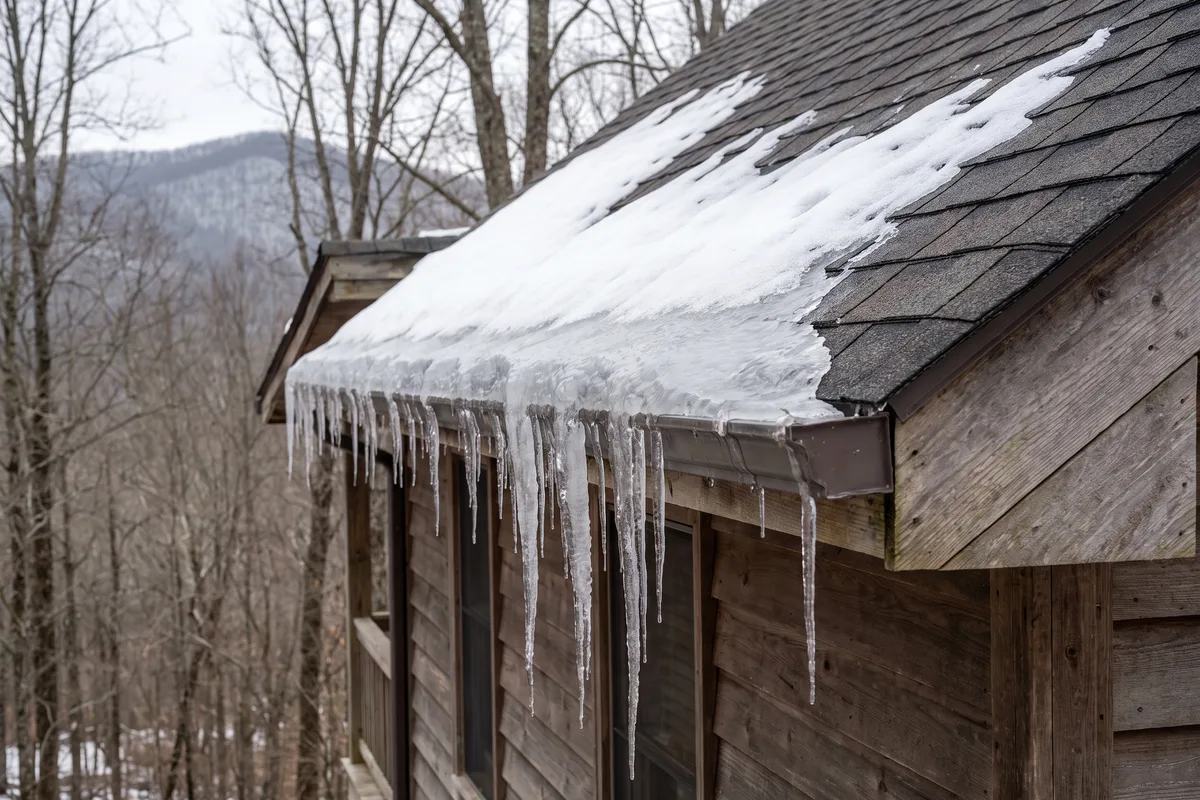
Clear the valleys and the gutters before you go. This is the highest-return maintenance item on a wooded lot, full stop. Packed debris in a valley holds a wet mass against the metal and the shingle edges for weeks, and it does not clear itself. Autumn, after leaf drop, is the trip to do it on.
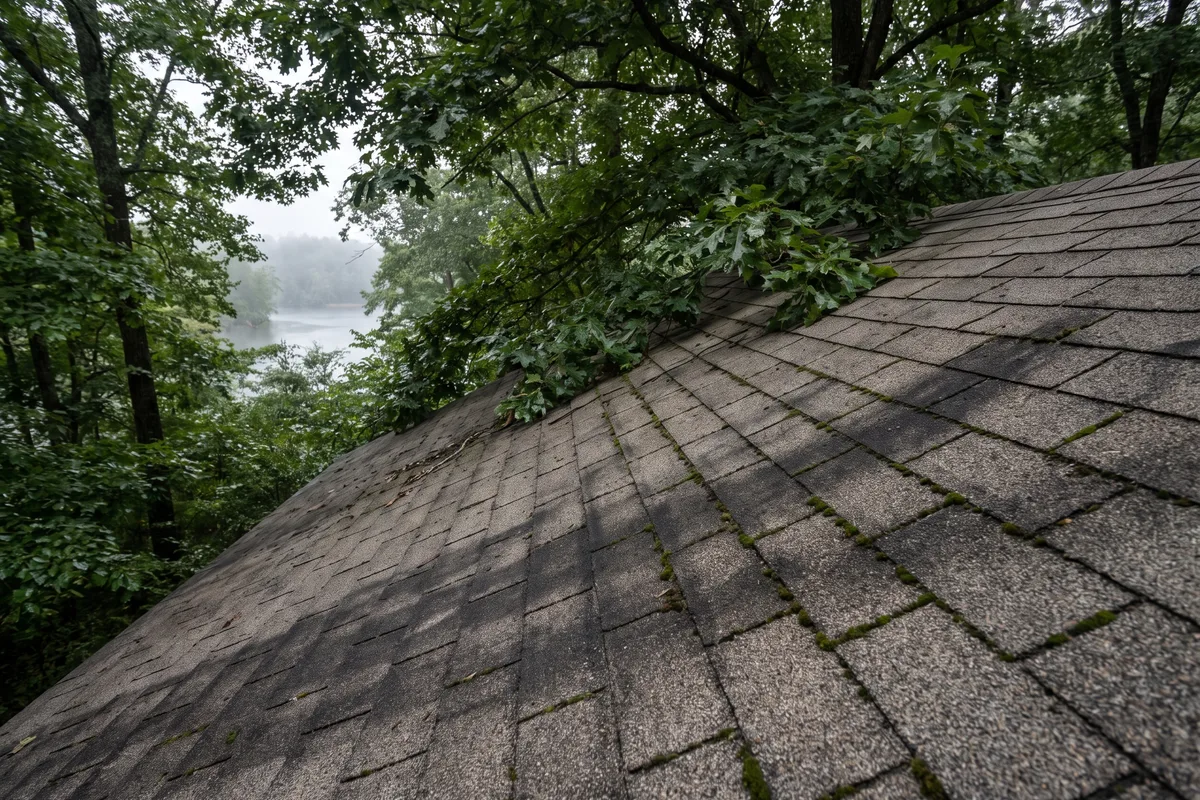
Deal with overhanging limbs. A limb over the roof is a debris source, a shade source and a future impact. Removing it is the only step here that improves the underlying condition instead of managing its consequences.
Time your inspections to the seasons that do the damage. Twice a year: once after winter, once after leaf drop. Both after the season that causes the problem, not before.
Ask a neighbour or caretaker to walk the perimeter after a big storm. They do not need to know anything about roofing. “Is there a limb on the roof, is there anything shiny in the yard that used to be on the house, is the driveway clear” is a useful report from anybody.
Get a set of photographs. Not for insurance drama — for the baseline. Knowing what the roof looked like in good condition, with a date attached, makes every later conversation about storm damage a factual one rather than an argument about what was already there.
What we do on a cabin inspection
A cabin inspection is not the same visit as an occupied-house inspection, and it should not be scoped like one.
We inspect by hand, on the roof, which on a mountain property means the access has to be planned rather than improvised. We work through the penetrations and flashings first, because that is where the odds are, then the valleys and the debris load, then the field of the roof, then the eaves and the edge details. If there is an attic we get in it. If it is a cathedral build we say so, and we are honest that the interior evidence is thinner in that kind of house and the exterior work has to carry more of the diagnosis.
You get photographs of what we found, including the parts that are fine. For an owner who is three hours away and will not be back until October, the photographs are most of the value — they are the thing that lets you make a decision from your kitchen table instead of guessing.
Our crew brings 40+ years of combined experience across the cabin markets in Fannin, Gilmer and Pickens County, and we are used to working around a visit schedule rather than expecting someone to be home.
Just walked back into a cabin that smells wrong? Contact True Hand Roofing for a free inspection, or call (706) 455-9009. You can also get an instant estimate if you already know a replacement is coming.
Related reading: How to Find a Roof Leak | Why You Shouldn’t Ignore a Minor Roof Leak | 5 Overlooked Problems Found During a Roof Inspection