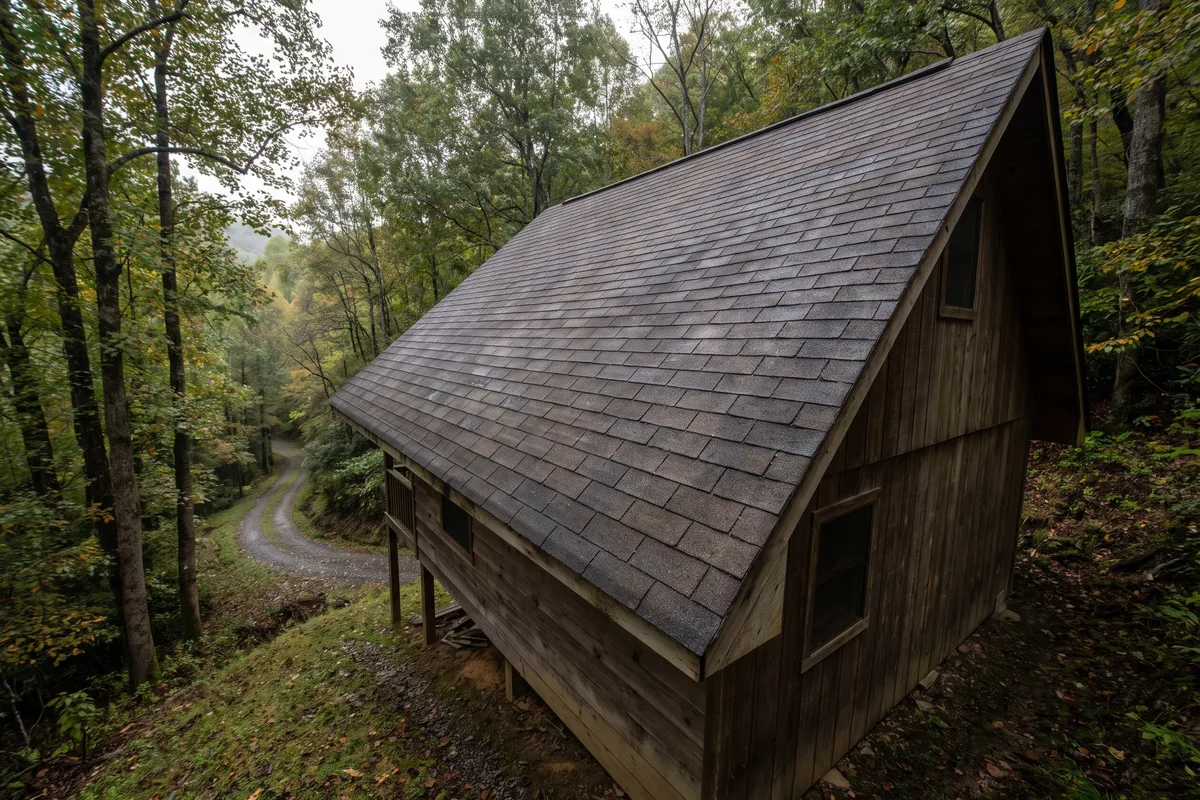

Drive the roads around Lake Blue Ridge or Lake Nottely in late summer and you will see the same thing over and over: a house whose south slope looks close to new and whose north slope is running dark vertical streaks from ridge to gutter. Same roof. Same age. Same installer. Same shingles out of the same bundles.
That is not a shingle problem, and it is not storm damage. It is a growing organism, and the reason it picks one slope and one kind of lot is a good deal more interesting than “the north side gets dirtier.”
What the streaks actually are
The dark staining on an asphalt roof is algae. The Asphalt Roofing Manufacturers Association identifies Gloeocapsa magma as “probably the most prevalent of several algae species that contribute to discoloration,” and notes that discoloration “may appear uniform or as streaks.”
It is a cyanobacterium. It lives on the surface of the shingle, produces a dark pigmented sheath as protection against ultraviolet light, and colonises anywhere it finds the conditions it likes — which ARMA sums up as “warm, humid conditions.”
North Georgia in July supplies warmth without any effort. So the variable that decides which roofs streak, and which slopes on those roofs streak first, is the other one: how long the surface stays wet.
Drying time is the whole story
Think about how long a roof plane stays damp after a night of dew.
A south-facing slope on an open lot catches direct sun from mid-morning. It is dry by ten. A north-facing slope on the same house gets no direct sun at all for most of the year — it dries by evaporation into whatever air is passing over it, and it does that slowly.
Now start adding the things that are normal on a mountain lake lot:
- Hardwood canopy. A tree line on the north side does not just block the sun that the slope was not getting much of anyway. It blocks the wind, and wind is what carries the moisture away.
- Open water nearby. A large body of water keeps the air above and around it more humid, particularly in the mornings. Air that is already close to saturated is poor at drying anything.
- A cove or a hollow. Lake lots often sit in low, sheltered ground, where cool air pools overnight and fog sits into the morning.
Each one of those extends the wet hours on that plane. Stack them and a north slope on a shaded lakefront lot can be damp for a substantially larger share of the year than the south slope thirty feet away — which is exactly the difference you are looking at when one side is streaked and the other is not.
The two lakes this describes
Two reservoirs sit inside our footprint, and both are large enough to matter to the air around them.
Lake Blue Ridge is a Tennessee Valley Authority impoundment of the Toccoa River in Fannin County, formed by Blue Ridge Dam. It covers about 3,300 acres with roughly 60 miles of shoreline. Sixty miles of shoreline is a lot of houses at the water’s edge, and Morganton sits on its northeast side, about six miles from Blue Ridge itself.
Lake Nottely is also a TVA reservoir, on the Nottely River in Union County, dammed in 1942, with a normal pool elevation of 1,779 ft. Blairsville sits just south of it at 1,893 ft.
Neither of these is a decorative pond. They are working reservoirs with long, indented shorelines and steep wooded banks, and the housing on them is exactly the stock this article is about: cabins and lake houses, often tucked into a cove, often under mature hardwood, often with one roof plane that never sees the sun.
The pattern is not confined to those two. Dawsonville sits on the northern arm of Lake Lanier and has the same condition on its shoreline homes. And you do not strictly need a lake — a deeply shaded lot under the canopy around Mineral Bluff or in the headwaters country near Cleveland produces the same slow-drying north slope without any open water at all. Water just makes it more reliable.
Why streaks, and why downward
The streaking pattern itself is a clue that people misread.
Algae colonises where it lands and where water carries it. Spores arrive on the wind, land near the ridge, and then every rainfall washes some of them downslope. What you get is not a random blotch but a set of vertical runs — the drainage paths on that plane made visible. Where something interrupts the flow, the pattern shows it: a clean fan below a chimney or a skylight where the flashing throws water sideways, a heavier streak below a valley that concentrates runoff, a sharp stop at a course where a metal component crosses the slope.
That last one is worth noticing. If you already have a copper or galvanised component partway down a streaked slope — a vent flashing, a length of drip edge, an old chimney counter-flashing — you will often see a visibly cleaner band directly below it. That is the metal-ion effect happening by accident, and it is the best possible demonstration that zinc and copper strips do something.
What is actually worth doing
In rough order of value on a shaded or lakeside roof in this area:
Specify algae-resistant shingles at replacement. ARMA confirms that shingles “specifically designed to inhibit algae growth for extended periods of time” are commercially available. On a slope that will be damp for its whole service life, the upcharge is small relative to the cosmetic outcome over 20 years. This is a decision you can only make once per roof, so make it deliberately — see our comparison of asphalt shingles vs. metal roofing if you are weighing the material question at the same time.
Put a zinc or copper strip near the ridge. Cheap, unobtrusive, and it works on everything the runoff crosses. Check that it actually drains over the slope you care about — a strip on the wrong side of a hip does nothing for the streaked plane.
Soft wash when the appearance bothers you. Low pressure, appropriate cleaner, no blasting. Understand what you are getting: ARMA is candid that “the effectiveness of such cleaning is only temporary, and the discoloration may recur.” Cleaning followed by a metal strip is a much better investment than cleaning on repeat.
Cut back what you can. Limbs overhanging the streaked slope are doing three things at once — casting shade, blocking wind, and dropping debris. Trimming them back is the only item on this list that improves the underlying condition rather than managing its result.
Keep the valleys clear. This is the one that stops being cosmetic. Which brings us to the real point.
Where it stops being cosmetic: moss and debris
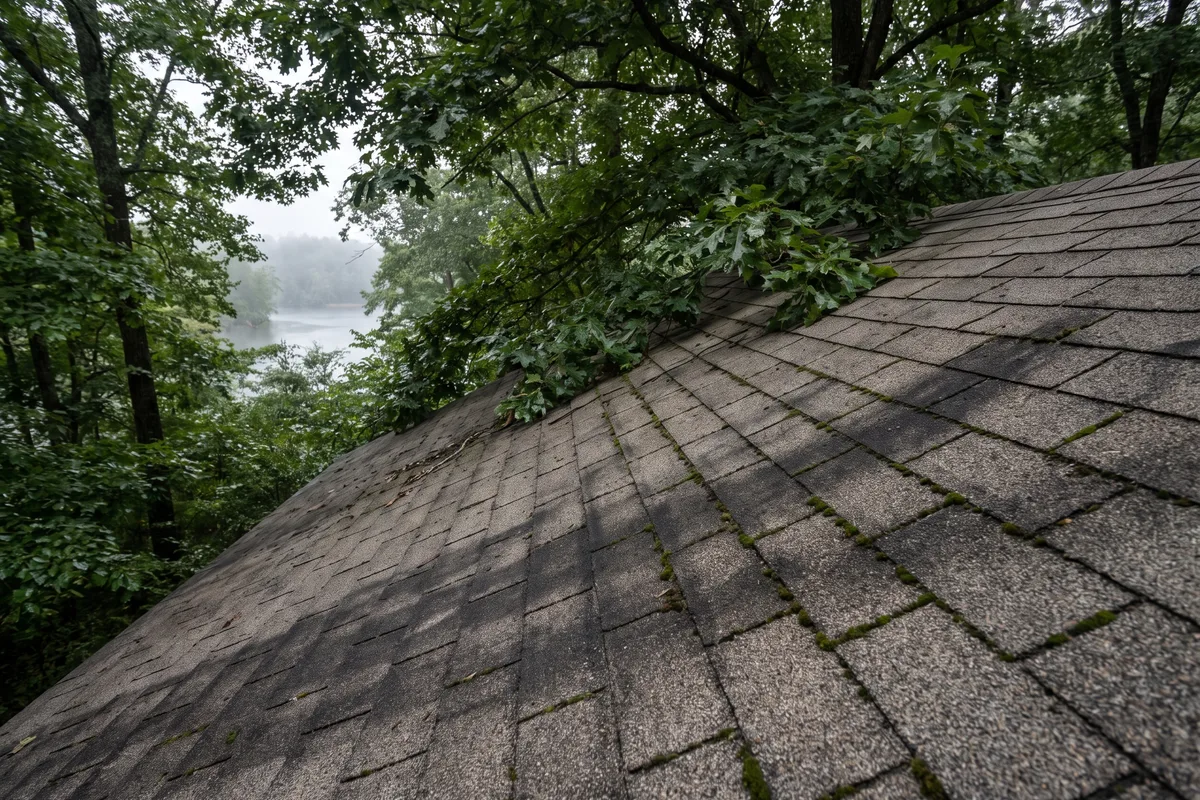
Algae is a stain. Moss is a sponge, and the conditions are the same conditions.
Moss is thicker, three-dimensional, and holds water against the shingle surface long after the rest of the roof has dried. As it establishes along a course, it lifts the shingle edge slightly, and a lifted edge is a capillary path — water can travel up under the lap rather than over it. Moss is a maintenance problem that turns into a repair.
The related failure is debris. A slow-drying north slope under canopy is also the slope that collects pine needles and leaf litter in its valleys, and that packed debris behaves exactly like moss on a larger scale: it holds a wet mass against the valley metal and the shingle edges either side of it, for weeks at a time, through every freeze the winter offers.
So the honest summary is this. The streaks themselves are cosmetic and you can reasonably decide to live with them. But they are a reliable marker of the slope on your house that stays wet longest — and that slope is where the moss, the packed valley debris, and eventually the underlayment problem will show up. It is worth knowing which plane that is.
What we look at on a shaded or lakeside roof
A hands-on inspection on this kind of house goes to specific places:
- The lower third of the shaded slope, where moss establishes first
- Valley debris depth, and whether the metal underneath has started to pit
- Shingle edges along the streaked courses — are any lifting, and if so is it moss or is it a seal failure
- The condition of granule cover in the streaked band compared with the clean slope
- Flashing at any penetration on the shaded plane, which will be the last thing on the roof to dry
- Gutters and downspouts on that side, since they carry the debris load from the slope that drops most of it
Our crew brings 40+ years of combined experience across the lake and cabin markets in Fannin and Union County, and every inspection is done by hand on the roof, not from the driveway with a long lens. If your north slope has been getting darker each summer and you want to know whether it is only cosmetic on your house, that is a straightforward thing to have checked.
Want a straight answer about your shaded slope? Contact True Hand Roofing for a free inspection, or call (706) 455-9009. You can also get an instant estimate if a replacement is on the table.
Related reading: 5 Overlooked Problems Found During a Roof Inspection | Your Annual Home Maintenance Checklist | Asphalt Shingles vs. Metal Roofing