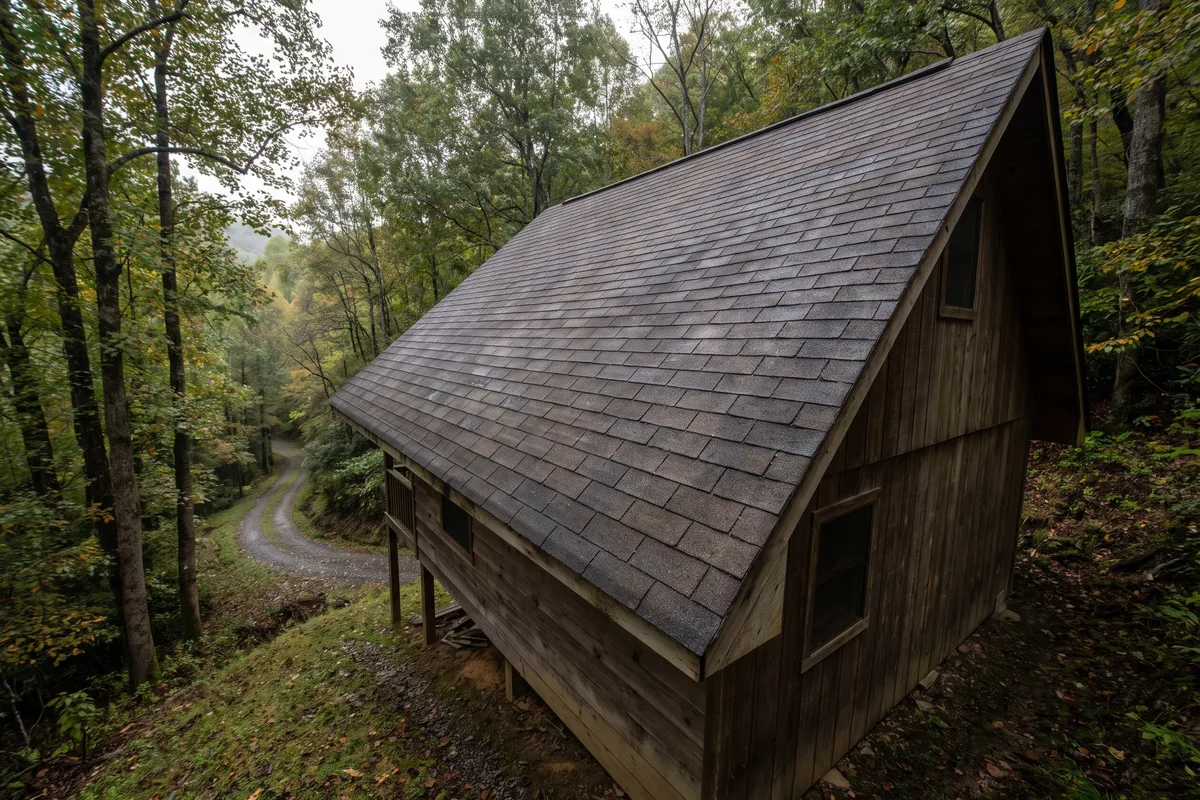

Most of what gets written about roofing in North Georgia is written about the mountains — steep cabin pitches, canopy debris, limbs coming down in an ice storm. That is fair, because that is where a lot of the housing is.
But a meaningful share of this area is not mountains at all, and out there almost every assumption flips. Fewer trees. Flat ground. Easy access. And a roof that takes wind with nothing whatsoever in front of it.
Two different pieces of country
Georgia contains parts of five physiographic provinces, and the boundary between two of them runs right through our service area.
The Blue Ridge province is the mountains proper — steep, high, heavily wooded. The Valley and Ridge province sits immediately to its west and looks nothing like it: long north-northeast trending ridges separated by broad, fertile valleys, formed by the erosion of alternating hard and soft sedimentary rock that was folded during the building of the Appalachians. Much of northwest Georgia lies in it.
The elevation numbers make the split obvious. These are the published elevations for town centers on each side:
| Town | Elevation | County | Province |
|---|---|---|---|
| Calhoun | 659 ft | Gordon | Valley and Ridge |
| Plainville | 679 ft | Gordon | Valley and Ridge |
| Adairsville | 719 ft | Bartow | Valley and Ridge |
| Chatsworth | 745 ft | Murray | valley floor, Cohuttas to the east |
| Cartersville | 787 ft | Bartow | Valley and Ridge |
| Ellijay | 1,280 ft | Gilmer | Blue Ridge |
| Blue Ridge | 1,762 ft | Fannin | Blue Ridge |
| Blairsville | 1,893 ft | Union | Blue Ridge |
Calhoun sits more than 1,200 feet below Blairsville. They are in the same service area and they are not in the same landscape.
What tree shelter was doing for you
Here is the thing that is easy to miss about a wooded lot: the canopy is a liability in an ice storm and an asset in a wind event, and out west of the divide you have neither.
A mature tree line upwind of a house disrupts the airflow before it reaches the roof. It does not eliminate wind — it makes it turbulent and slower at roof height. Take that away and put the same house on an open valley lot with pasture upwind, and the air arrives at the eave essentially undisturbed and moving at whatever speed it was moving at.
This is why the roofing conversation in Calhoun, Plainville and across Gordon County is a fastening and edge-detail conversation, where the same conversation in Fannin County is about steep-slope access and debris. Same trade. Different failure to design against.
Where a roof actually feels the load
Wind does not press evenly on a roof, and it does not mostly press downward. As air moves over a roof plane it accelerates, and accelerating air drops in pressure — so the dominant force on most of a roof during a wind event is suction pulling upward, not pressure pushing down.
That suction is not uniform. It concentrates at the discontinuities, which is to say:
- Corners take the highest loads on the roof, by a wide margin
- Perimeter edges — the eave, the rake — take the next highest
- The ridge takes elevated load, particularly on the windward side
- The middle of a slope — the part everyone looks at — takes the least
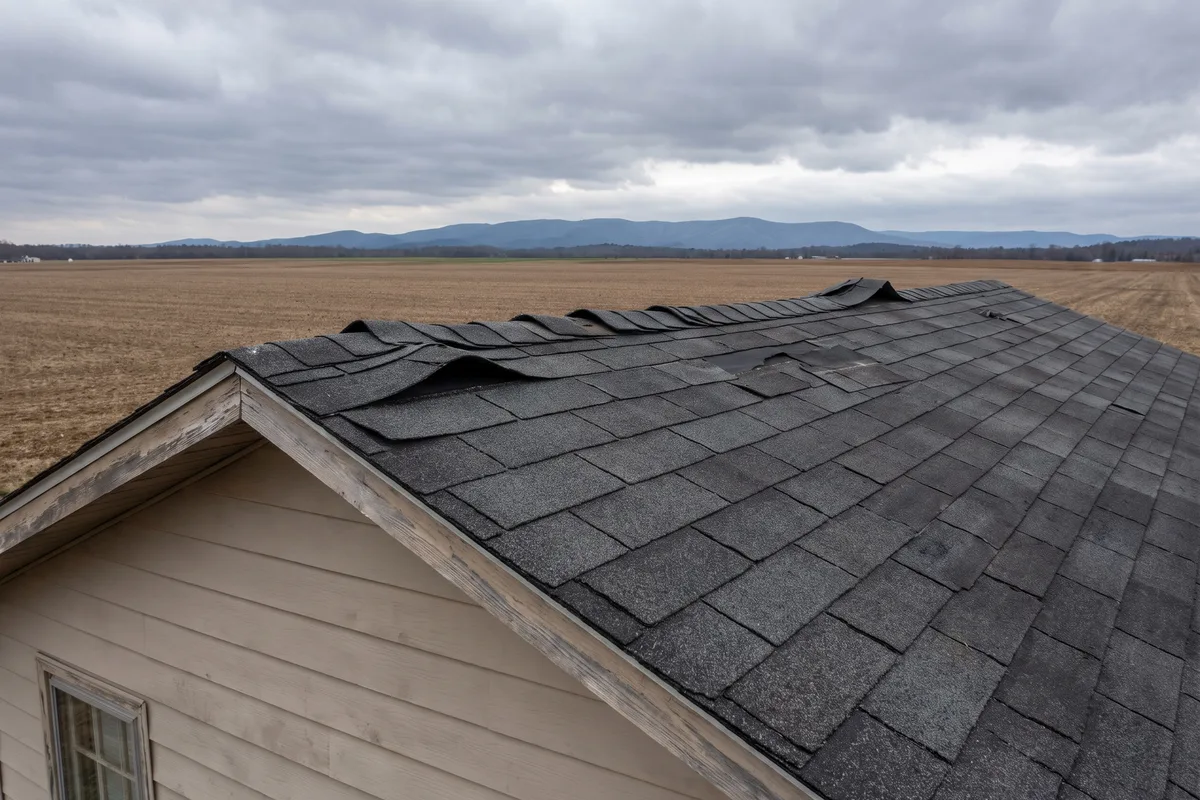
This is why an open-lot roof does not fail in the middle. It starts at a rake edge or a corner, gets a shingle edge lifted, and then unzips: once one shingle’s leading edge is free, the wind has a purchase point on the one above it.
Everything about protecting an exposed roof follows from that geometry. Starter course at the eaves and the rakes, correctly oriented so the adhesive lands under the shingle edge. Properly fastened drip edge and rake metal. Nailing pattern and placement per the manufacturer’s high-wind instruction, which usually means more fasteners in the perimeter zones, not the same six everywhere. Ridge caps that are actually rated for the exposure.
The seal strip is the whole game
Underneath all of that sits one component that decides more outcomes than any other: the factory-applied sealant strip.
Nearly every asphalt shingle sold today is a self-sealing shingle. A bead of thermally activated adhesive on the shingle face bonds to the underside of the shingle laid over it, once the roof gets warm enough to activate it. That bond, not the nails, is what keeps the leading edge of each shingle down against uplift. A nailed but unsealed shingle is a flap.
Two things routinely stop that bond forming or hold it:
Cold-weather installation. The adhesive needs heat. ARMA’s cold-weather guidance notes that asphalt shingles “include thermally activated asphalt sealant, which bonds the shingles together after they are applied to the roof,” and that for improved protection from wind blow-off in very cold weather, shingles “can be hand-sealed with an approved asphalt roofing cement or other adhesive acceptable to the shingle manufacturer.” The same document warns that cold shingles “may crack, or in severe cases, break apart” in handling, and recommends storing them indoors before application. A December re-roof on an exposed Bartow County lot that goes on without hand-sealing may sit unsealed through the windiest part of the year.
A previous wind event. This is the one homeowners never catch. A gust can break the seal bond without moving the shingle far enough to be visible. It settles back down looking identical to its neighbours, and it is now a flap waiting for the next storm. Broken seals are found by hand, by lifting the edge, which is a large part of why we are not willing to call a driveway inspection an inspection.
What the wind ratings do and do not tell you
Shingle packaging carries wind ratings, and the numbers invite a comparison they do not support.
There are two standards in play. ASTM D3161 is a fan-driven test: a panel of properly installed, conditioned shingles is exposed to a constant wind stream. Its classes are A at 60 mph, D at 90 mph, and F at 110 mph, with F the highest available under that standard. ASTM D7158 works differently — it measures the force needed to break the sealant bond and calculates uplift for various design wind speeds, with classes D, G and H, and H the top rating.
Three things follow, and all three are worth knowing before you buy:
- The numbers are not comparable across standards. Different methods, different scales. A Class F 110 mph shingle is not a weaker product than a 150 mph figure quoted from the other standard.
- Neither number is a promise about your house. ASTM D3161 carries the flat disclaimer that “the results of this test do not directly correlate to wind speeds experienced in service.”
- Your exposure is not in the D3161 number at all. That standard “makes no accommodation for building height or mean roof height, building exposure, building importance factor or risk category.” Exposure is precisely the variable that distinguishes an open pasture lot from a sheltered one — and the fan test does not see it.
None of which makes ratings useless. A shingle that passes the top class of either standard is a better-engineered product than one that does not, and it is the right thing to specify on an exposed lot. Just do not treat the number on the wrapper as a survival threshold, and be sceptical of anyone who quotes it to you as one.
After a wind event on an open lot
The single most common mistake we see out west of the divide is a homeowner deciding nothing happened because the yard is clean.
On a wooded mountain lot, “nothing came down” is reasonable evidence. On an open lot there was nothing to come down in the first place. The damage signature here is different, and it is quiet:
- One slope, not the whole roof. Wind has a direction. The windward plane and the rake edge that faced the gust can be damaged while three other planes are untouched.
- Creased shingles that are still in place. A shingle lifted and slapped back down carries a horizontal crease across the mat. From the ground it looks fine. It is a future leak.
- Broken seals with no visible movement. Only findable by hand.
- Edge metal and ridge cap. Lifted drip edge, a rake run pulled at one end, ridge caps missing at one end of the run.
- Granules at the downspouts. A pile at the base of a downspout after a wind event says the surface took a beating even if nothing left the roof.
If a storm has been through and you are in Bartow County or Chatsworth or anywhere on the valley floor, the useful move is a documented inspection while the storm date is fresh — not because something is certainly wrong, but because “we looked, here are the photographs, here is what we found” is worth having either way. Our guide to telling hail damage from wind damage covers how the two signatures differ.
What we do about it
We inspect by hand, on the roof, and we photograph what we find — including the things that argue against a claim, because a homeowner making a decision needs the whole picture rather than the flattering half. If there is damage, you get documentation you can submit and a plain explanation of what the findings mean. You run your own claim; we make sure the evidence is complete.
Our crew brings 40+ years of combined experience across both sides of this divide, which is genuinely useful here — knowing what an exposed valley lot fails at is different knowledge from knowing what a canopy lot fails at, and this service area has both.
Storm been through an open lot? Contact True Hand Roofing for a free inspection, or call (706) 455-9009. You can also get an instant estimate if you are already weighing replacement.
Related reading: Hail Damage vs. Wind Damage | 5 Mistakes When Filing a Roof Insurance Claim | 7 Telltale Signs You Need a Roof Replacement